
What Is a Stake Amount and How It Affects Your Payout

Your stake amount is the money you put at risk on a single wager. That one number controls both how much you can win and how much you can lose. Put $20 on a bet at decimal odds of 3.0, and your total return is $60 ($40 profit). Lose, and that $20 is gone. The Cambridge Dictionary defines a stake as "the amount of money that you risk on the result of a game or competition," which is exactly how every sportsbook uses the word.
The formula is simple: Total return = stake × decimal odds. Profit is total return minus your original stake.
Table of Contents
- What is a stake amount and how do you calculate it?
- Common staking strategies and which one fits you
- Stake vs. bet: why the difference matters
- How to choose the right stake for your bankroll
- Kelly Criterion: the math behind sizing stakes
- Key Takeaways
- Why discipline beats strategy every time
- Useful sources and further reading
What is a stake amount and how do you calculate it?
The math behind a stake amount changes slightly depending on which odds format your sportsbook uses. Here is how each one works.

Decimal odds are the most straightforward. Multiply your stake by the decimal odds to get your total return, then subtract the stake for profit. A $50 stake at 2.50 returns $125 total, or $75 profit.

Fractional odds (common in horse racing) express profit relative to stake. Odds of 5/2 mean you earn $5 profit for every $2 staked. On a $20 stake: profit = $20 × (5 ÷ 2) = $50, total return = $70. To use the decimal formula, convert first: 5/2 = 2.5, then add 1 to get 3.5 as the decimal equivalent.
American odds split into positive and negative. Positive odds (e.g., +200) show profit on a $100 stake. Negative odds (e.g., -150) show how much you must stake to earn $100 profit.
- +200 on a $50 stake: profit = $50 × (200 ÷ 100) = $100; total return = $150
- -150 on a $50 stake: profit = $50 × (100 ÷ 150) = $33.33; total return = $83.33
| Stake | Odds (Decimal) | Total Return | Profit |
|---|---|---|---|
| $10 | — | $20 | $10 |
| $20 | 3.0 | $60 | $40 |
| $50 | — | $75 | $25 |
One important caveat: the displayed stake on a bet slip does not always equal your total financial exposure. Lay bets on exchanges, partial cash-outs, and each-way bets can all change what you actually stand to lose beyond the number shown. Free bets also work differently since you typically only receive the profit, not the stake back.
Common staking strategies and which one fits you
Knowing the stake amount definition is step one. Knowing how much to stake is where most beginners go wrong.
Flat staking means betting the same dollar amount every time, regardless of confidence or odds.
- Pros: Simple, disciplined, easy to track.
- Cons: Ignores edge size; a high-confidence bet gets the same stake as a coin flip.
- Best for: Beginners who want a no-fuss starting point.
Unit/percent staking ties each bet to a fixed percentage of your current bankroll, typically 1–5%. (no error)
- Pros: Stakes shrink during losing runs, protecting your bankroll automatically.
- Cons: Requires consistent bankroll tracking.
- Best for: Anyone serious about longevity.
Proportional (Kelly-style) staking scales the stake to your estimated edge. More on this in the Kelly section below.
- Pros: Mathematically optimal when your edge estimate is accurate.
- Cons: Demands honest probability estimates; overconfidence is punishing.
- Best for: Experienced bettors with a documented edge.
Progressive systems (Martingale-style) double the stake after each loss to recover previous losses in one win.
- Pros: Feels intuitive; one win wipes the slate.
- Cons: Catastrophic during losing streaks; sportsbook limits and bankroll ceilings make this dangerous in practice.
- Best for: Nobody serious about bankroll management.
Stake vs. bet: why the difference matters
People use "stake" and "bet" interchangeably in casual conversation, but they mean different things in practice. The bet is the selection, the market or outcome you are predicting. The stake is the money you assign to that selection.
Two quick examples make this concrete:
- Same bet, different stakes: You and a friend both pick the Kansas City Chiefs to win. You stake $10; your friend stakes $100. The bet is identical. The financial exposure and potential return are not.
- Different bets, same stake: You stake $25 on the Chiefs moneyline. You also stake $25 on the over/under. Two separate bets, same stake amount on each.
Confusing the two causes real problems in record-keeping. If you log "bet $50 on the Chiefs" without separating the selection from the amount, you cannot accurately track your return on investment per market type. Keeping them distinct is the foundation of any honest betting log.
How to choose the right stake for your bankroll
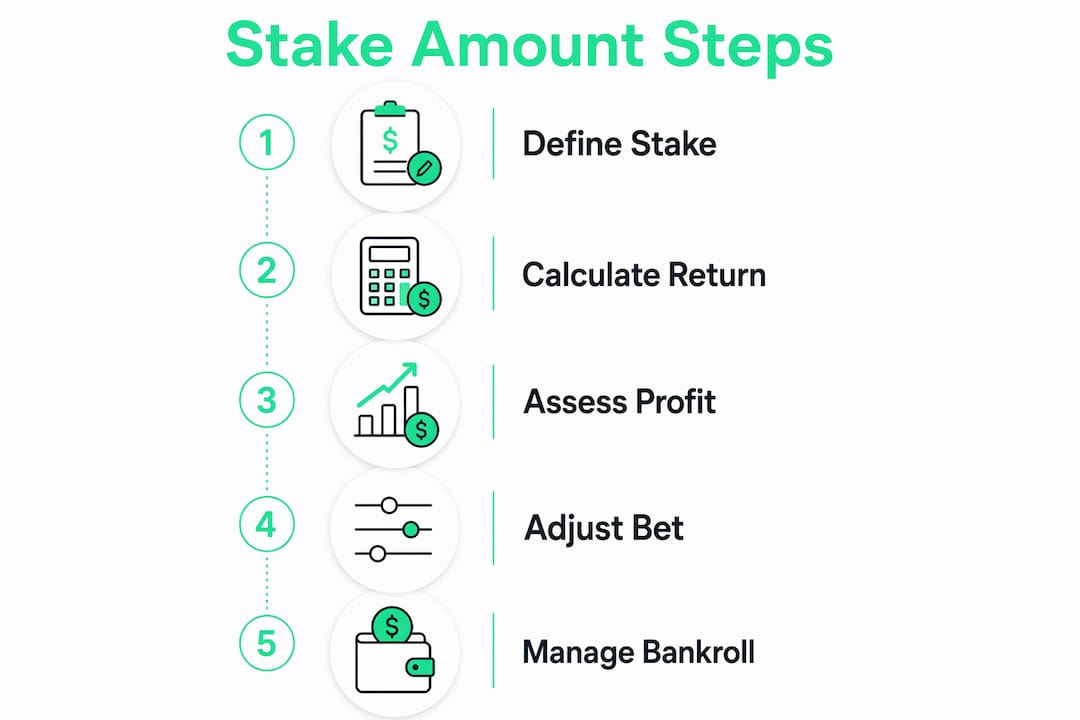
The first rule has nothing to do with math: your betting bankroll must be money you can afford to lose entirely. Separating bankroll from bill money is the single most important behavioral habit for new bettors. Once that separation is real, sizing becomes a process.
Practical rules of thumb:
- Set a bankroll. Decide a fixed amount dedicated to betting, separate from living expenses.
- Define a unit. Most experienced bettors set one unit at 1–5% of their bankroll. On a $500 bankroll, one unit = $5–$25. Common bankroll rules recommend keeping each stake between 1% and 5% of your dedicated betting bankroll to limit drawdown risk. Staking more than 5% per bet accelerates ruin during losing streaks.
- Translate confidence into units. A standard bet might be 1 unit; a high-confidence bet, 2 units. Rarely go above 3 units on any single wager.
- Track every bet. Without records, you cannot tell whether your sizing is working.
Before setting any stake, ask yourself:
- Do I have a genuine reason to think I have an edge here, or am I guessing?
- What percentage of my bankroll does this represent?
- Am I chasing a loss from an earlier bet?
- Does this bet correlate with another open bet, doubling my real exposure?
Red flags to watch: staking more after a loss to "get even," using money earmarked for rent or bills, and ignoring how free-bet promotions change your actual exposure. The Stakestats bankroll analyzer lets you plug in your bankroll and unit size to see what different percentage rules look like in dollar terms before you commit.
Kelly Criterion: the math behind sizing stakes
The Kelly Criterion is the mathematically grounded answer to "how much should I stake?" It converts your estimated edge into a specific bankroll fraction. The formula, as used by Kelly stake calculators, is:
f* = (b × p − q) ÷ b
Where:
- f* = fraction of bankroll to wager
- p = your estimated probability of winning
- q = 1 − p (probability of losing)
- b = net odds (decimal odds minus 1)
If the result is zero or negative, Kelly recommends no bet at all. No edge, no stake.
The problem with full Kelly is volatility. Practitioners widely use fractional Kelly, typically half or quarter Kelly, to reduce drawdowns while still sizing proportionally to edge. On a full Kelly suggestion of 10% of bankroll, half Kelly means staking 5%.
For most beginners, a simple 1–5% fixed-unit rule is more practical than Kelly because it requires no probability estimate and keeps you in the game during losing stretches. Kelly is best treated as a ceiling, not a target.
Pro Tip: Run your Kelly calculation, then cut the output in half. That half-Kelly figure is your maximum stake. If the math feels uncomfortable, drop to a quarter Kelly. The goal is staying solvent long enough for your edge to play out.
Key Takeaways
A stake amount is the money you risk on one bet, and sizing it correctly is the highest-leverage skill for any new bettor.
| Point | Details |
|---|---|
| Stake amount definition | Your stake is the money you risk on a single wager; lose and it's gone, win and you get it back plus profit. |
| Payout calculation | Total return = stake × decimal odds; profit = total return minus your original stake. |
| Safe sizing rule | Keep each stake between 1% and 5% of your dedicated betting bankroll to limit drawdown risk. |
| Kelly as a guide | Use the Kelly formula (f* = (b × p − q) ÷ b) to size by edge, but apply half or quarter Kelly in practice. |
| Bankroll separation | Keep betting funds completely separate from essential money before sizing any stake. |
Why discipline beats strategy every time
Most beginners spend their energy hunting for the perfect bet. The smarter move is getting the stake size right first. A well-chosen selection with an oversized stake can still wreck a bankroll; a mediocre selection with disciplined 1–2% staking rarely does permanent damage.
The math here is not complicated, but the psychology is. Losing streaks feel like they demand a correction, a bigger bet to get back to even. That instinct is exactly what burns most new bettors. Flat staking or fractional Kelly removes the decision from the moment of emotional pressure and replaces it with a rule you set when you were thinking clearly.
If you want to put these principles into practice, the Stakestats bankroll analyzer gives you a concrete starting point. For responsible gambling support, GambleAware and the National Problem Gambling Helpline at 1-800-522-4700 are free resources available to anyone in the United States.
Good stake habits, built early, compound over time in ways that no single winning bet ever will.
Useful sources and further reading
- Stake definition: Cambridge English Dictionary and bettingexpert Glossary for plain-English definitions of stake in a betting context.
- Kelly Criterion calculator: CalculateMyBet Kelly Stake Sizer converts your bankroll, odds, and win probability into a suggested stake fraction.
- Kelly explainer: Expected Value Kelly Criterion Calculator walks through the formula with plain-language variable explanations.
- Bankroll rules: VegasOdds Betting 101 covers the 1–5% unit rule and practical staking guidance.
- Stakestats tools: The Stakestats bankroll analyzer and bonus exposure tools help you translate these rules into real dollar amounts and understand how promotions change your actual stake exposure.
- Responsible gambling: GambleAware and 800gambler.org offer free support and self-assessment tools.
This article is general information, not financial or gambling advice. Confirm current rules and limits with your sportsbook or a qualified professional before wagering.