
What Is a True Odds Bet? A Crypto Bettor's Guide

A true odds bet reflects the actual probability of an outcome with zero sportsbook profit baked in. No margin, no vig, no house edge padding the number. Analysts at TheOver.AI and TrueProb describe these as "fair odds" or "no-vig odds" — all three terms mean the same thing: the raw mathematical probability of something happening, expressed as a betting line.
Why does this matter? Because every line a sportsbook posts is not a true odds bet. The posted line is a true odds line plus the bookmaker's cut. Once you understand that gap, you can start identifying bets where the posted price actually exceeds the fair value — what the industry calls a value bet. Stakestats tools, including the bankroll analyzer and provably fair verification, give crypto bettors a concrete way to apply this thinking.
Key terms to keep straight:
- True odds — the fair probability of an event, no margin included
- Implied odds — the probability implied by a sportsbook's posted line, which includes the vig
- Overround — the sum of all implied probabilities in a market, always above 100% when vig is present
- Vig (vigorish/juice) — the bookmaker's built-in profit margin
Table of Contents
- How do you calculate true odds from sportsbook lines?
- How sportsbooks build their margin into every line
- Why true odds knowledge is your edge on provably fair crypto platforms
- What happens when you get the calculation wrong?
- Stakestats gives you the transparency layer crypto bettors need
- Key Takeaways
How do you calculate true odds from sportsbook lines?
The process has three steps: convert posted odds to implied probabilities, measure the overround, then normalize. Here is how it works in practice.
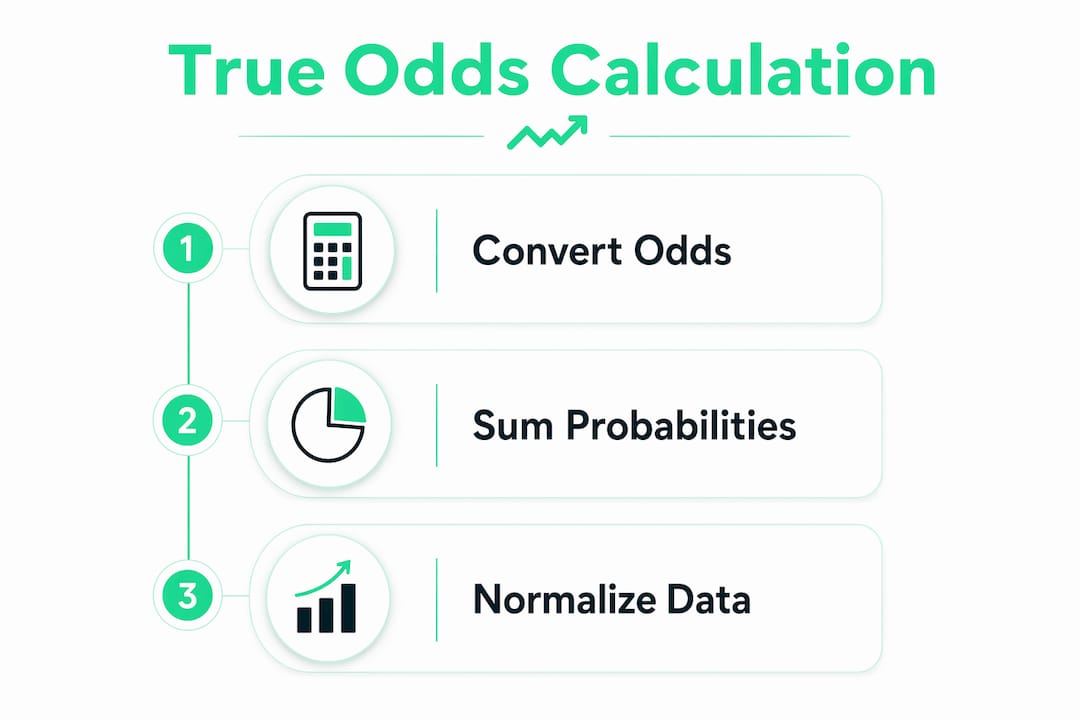
Step 1: Convert each side's odds to an implied probability.
For American odds, the formula differs by sign:
- Negative odds: Implied probability = |odds| / (|odds| + 100)
- Positive odds: Implied probability = 100 / (odds + 100)
Step 2: Sum the implied probabilities to find the overround.
A market with no vig would sum to exactly 100%. Any total above that is the overround, and the excess is the vig.

Step 3: Divide each implied probability by the total overround.
This is the de-vigging process. If a favorite carries a 60% implied probability in a market where the total implied probability exceeds 100%, the true probability is found by dividing by that total overround, reducing it appropriately.
- Write down each side's implied probability.
- Add them together to get the overround percentage.
- Divide each individual probability by the overround total.
- The resulting numbers are your true probabilities.
- Convert back to odds format if needed: true odds = (1 / true probability) − 1 in decimal, or the American equivalent.
Pro Tip: The proportional method above is the fastest approach for two-way markets. For three-way markets (win/draw/win in soccer), the Shin method distributes vig more accurately by accounting for the possibility that insiders drive line movement — worth learning if you bet soccer regularly.
Two common de-vigging approaches:
- Proportional method — removes vig proportionally from each side; fast and sufficient for most two-way markets
- Shin method — assumes some market participants have inside information and adjusts accordingly; more precise for larger fields or three-way markets
How sportsbooks build their margin into every line
The vig is not a fee you see on a receipt. It is structural, embedded directly into the odds themselves. A 50/50 coin flip should price at +100 on both sides. Sportsbooks typically post it at odds slightly less favorable than true odds, pushing each side's implied probability above 50%, and the total market over 100%. This overround guarantees the sportsbook’s edge, increasing the break-even win rate above 50%. The house does not need to pick winners. It just needs to balance action and collect the spread.
Key mechanics of how the margin works:
- Sportsbooks set lines so total implied probabilities always exceed 100%
- The overround guarantees profit regardless of which side wins
- Sharper bettors force books to move lines, but the vig stays embedded
- Bigger markets (NFL, NBA) often carry tighter margins than niche sports
The structural reality: sportsbooks never offer true odds intentionally. The margin is the product. Understanding this shifts your mindset from "are these odds fair?" to "how far off fair are they, and is there still value?"
Sportsbooks structure markets to maintain their edge regardless of outcome — the overround is the mechanism, not a mistake.
Why true odds knowledge is your edge on provably fair crypto platforms
Value betting has a precise definition: you have a value bet when your assessed probability of an outcome is higher than the true probability implied by the posted line. Without calculating true odds first, you cannot know whether you have value or are just guessing.
Crypto-based provably fair platforms add a layer most traditional sportsbooks cannot match: verifiable transparency. The algorithms behind each outcome can be audited independently, which means the fairness of the underlying game is not a matter of trust — it is mathematically provable. That transparency makes true odds calculation more meaningful because you are working with verified probabilities, not just hoping the house is honest.
- Identify the posted line on the market you want to bet.
- Calculate the true probability using the de-vigging steps above.
- Compare your own probability estimate to the true probability.
- Bet only when your estimate exceeds the true probability — that gap is your expected value.
- Track results over a meaningful sample using a bankroll analyzer to separate skill from variance.
Professional handicappers treat true odds analysis as an ongoing research discipline, not a one-time calculation. The edge compounds when you apply it consistently across hundreds of bets, not just the ones that feel obvious.
Pro Tip: On provably fair platforms, use the provably fair verification tool to confirm game outcomes before calculating expected value. Verified fairness is the foundation — without it, your true odds math is built on an unverified assumption.
What happens when you get the calculation wrong?
Errors in true odds calculation are not neutral. They skew your perception of value in one direction: you think you have an edge when you do not.
The most common mistake is ignoring the overround entirely. If you treat a sportsbook's implied probabilities as true probabilities, you are systematically overestimating your edge on every single bet. A market showing 55% for the favorite and 48% for the underdog does not mean the favorite is a 55% shot — the true probability is closer to 54.0% after removing a typical margin.
A second error is mixing de-vigging methods across a single analysis. Using the proportional method for one side and the Shin method for the other produces probabilities that do not add to 100%, making any value comparison meaningless.
How to stay accurate:
- Always sum implied probabilities before drawing any conclusions about value
- Pick one de-vigging method and apply it consistently within each market
- Cross-check your true probability against multiple sources when the stakes are high
- Never treat a single calculation as definitive — line movement and new information change true probabilities
The cost of sloppy math is not just one bad bet. It is a systematically distorted model that bleeds bankroll slowly, which is harder to diagnose than a single obvious mistake.
Stakestats gives you the transparency layer crypto bettors need
Knowing the theory is one thing. Having tools that apply it in real time on provably fair platforms is another. Stakestats was built specifically for online gamblers on Stake.com and similar provably fair sites — the kind of bettors who want to verify, not just trust.

The platform covers the full toolkit: a bankroll analyzer to track whether your edge is real or variance-driven, a provably fair explanation hub that breaks down how algorithms work, bonus tracking to maximize value on every offer, and a Stake engine analysis tool for digging into game-level data. Every feature connects back to the same goal: replacing guesswork with verified numbers. If you are serious about applying true odds thinking on a provably fair platform, start with Stakestats and build your analysis on data you can actually verify.
Key Takeaways
True odds represent the fair probability of a betting outcome with no sportsbook margin, and identifying them is the only reliable way to find genuine value bets on any platform.
| Point | Details |
|---|---|
| True odds defined | Fair probability of an outcome with no vig; also called fair odds or no-vig odds. |
| De-vigging process | Divide each implied probability by the total overround (e.g., 60 ÷ 103.48 = 57.98% true probability). |
| Sportsbook margin | A -110/-110 market carries a 104.76% overround, requiring a 52.38% win rate just to break even. |
| Calculation errors | Ignoring overround or mixing de-vigging methods produces false value signals and steady bankroll losses. |
| Stakestats | Provides provably fair verification, bankroll analysis, and odds transparency tools for crypto bettors on Stake.com. |