
What Is Crash Gambling? Mechanics, Odds, and Strategy

Crash gambling is a multiplier-based casino game where players bet on a rising number and must cash out before it crashes, or they lose their entire stake. The game belongs to a distinct casino genre with over 100 million monthly active users globally and a house edge of 3–4%. Unlike slots, roulette, or sportsbook bets, crash gambling puts a single, time-sensitive decision at the center of every round: when do you leave? That decision feels personal and skill-based. Mathematically, it is not. Understanding that gap is the foundation of playing crash games without losing your bankroll to false confidence.
What is crash gambling and how does it work?
Crash gambling is defined as a provably fair betting game where a multiplier starts at 1.00x and climbs continuously until it crashes at a point determined before the round begins. Players place their bet during a short betting window, then watch the multiplier rise in real time. At any moment, they can hit "cash out" to lock in their winnings at the current multiplier. If the crash happens before they cash out, they lose their bet entirely.
The crash point is not random in the traditional sense. Outcomes are cryptographically locked before each round starts, using a provably fair algorithm based on cryptographic hashes. This means the platform cannot change the result mid-round, and players can verify the outcome after the fact. Each round is statistically independent. The game has no memory of previous rounds.

Round structure and multiplier probabilities
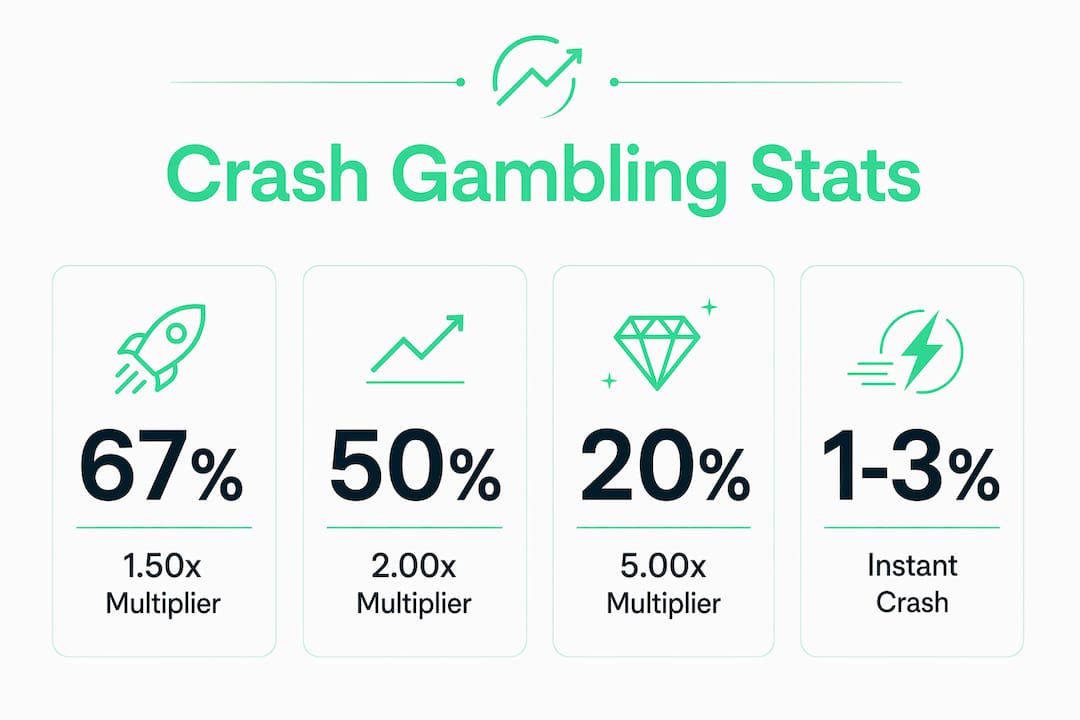
Each round lasts 8–30 seconds, making crash gambling one of the fastest casino formats available. The multiplier distribution is heavily skewed toward low values. The probability of reaching 2.00x is approximately 50%. The probability of reaching 100.00x is under 1%. That distribution is not a design flaw. It is the mathematical engine that funds the house edge.
| Multiplier Target | Approximate Probability |
|---|---|
| 1.50x | ~67% |
| 2.00x | ~50% |
| 5.00x | ~20% |
| 10.00x | ~10% |
| 100.00x | Under 1% |
A critical mechanic most players overlook: 1–3% of rounds are designed to crash instantly at 1.00x. These instant-crash rounds mean every player in that round loses their full bet before they can react. This is the primary mechanism enforcing the house edge, which produces an overall return to player of roughly 97%, comparable to European roulette.
Pro Tip: Set your target multiplier before the round starts, not while the number is climbing. Decisions made mid-climb are driven by emotion, not math.
Why crash gambling feels like a skill game
The illusion of skill is the defining psychological feature of crash gambling. Players manually time their cashout, which creates a feeling of personal control over the outcome. That feeling is real. The control is not. The crash point is already set before you place your bet, so your timing only determines whether you beat a threshold you cannot see.
This psychological dynamic is what separates crash games from slots. In a slot, you press a button and watch. In a crash game, you watch a number climb and make a choice. That active participation triggers a sense of responsibility for the result. When you cash out at 3.00x and the game crashes at 3.01x, it feels like a win you earned. When you hold too long and lose, it feels like a mistake you made. Both feelings are technically accurate, but neither changes the underlying math.
The social dimension of crash games
Crash games are shared real-time experiences. Most platforms display other players' bets and cashout points as the multiplier climbs. Watching someone cash out at 15.00x while you are still holding amplifies greed. Watching someone lose at 1.20x while you cashed out at 2.00x amplifies confidence. Both reactions push players toward worse decisions in the next round.
The shared format makes crash gambling more emotionally intense than traditional slots. That intensity is a feature from the platform's perspective. From the player's perspective, it is a risk factor that requires active management.
Pro Tip: Ignore other players' cashout points during a round. Their decisions have zero effect on your outcome. Watching them only feeds emotional reactions.
Key psychological risks to watch for:
- The greed trap. Holding past your planned cashout because the multiplier keeps climbing.
- Loss chasing. Increasing bet size after a losing round to recover losses faster.
- Overconfidence after wins. Assuming a streak of successful cashouts reflects skill rather than variance.
- Social pressure. Adjusting your strategy based on what other visible players are doing.
Crash betting strategy: what actually works
No strategy can overcome the house edge in crash gambling. That is not a caveat. It is the central fact any serious player must accept before developing a plan. The house edge is built into the crash point distribution, and no cashout timing, bet sizing system, or pattern recognition changes that math.
What strategy can do is control variance and extend your session. These are meaningful goals. A player who manages their bankroll well will lose more slowly, experience more rounds, and make better decisions under less financial pressure.
Practical tips for managing your bankroll
- Set a session loss limit before you start. Decide the maximum you will lose in one session and stop when you hit it. Do not recalculate mid-session.
- Use auto-cashout. Auto-cashout features reduce losses from reaction delays, screen lag, and emotional errors. Set a target multiplier and let the system execute it.
- Keep bets small relative to your bankroll. High variance means long losing streaks are normal. Betting 5–10% of your session bankroll per round gives you enough rounds to survive variance.
- Target low multipliers consistently. Aiming for 1.50x or 2.00x gives you a statistically higher chance of cashing out than chasing 10.00x or higher.
- Avoid the Martingale system. Doubling your bet after each loss is a common approach that accelerates bankroll depletion during losing streaks, which are inevitable.
Bankroll management and loss limits are the two most effective tools available to crash gamblers. They do not improve your odds. They protect you from the worst outcomes of bad variance.
Common myths about crash gambling
Crash gambling attracts more misinformation than almost any other casino format. The interactive format and the illusion of skill create fertile ground for false beliefs about how the game works.
Myth: You can predict the crash point by watching patterns. The crash point is cryptographically predetermined before the round begins. Each round is statistically independent. No sequence of previous results gives any information about the next crash point. Pattern recognition in crash gambling is the same as pattern recognition in coin flips.
Myth: Predictor tools and software can forecast crashes. No software or predictor tool can forecast crash points. Any tool claiming otherwise is a scam. These tools typically display random numbers or historical data dressed up as predictions. They have no access to the cryptographic seed that determines the crash point.
Myth: Crash gambling is a skill game. Crash gambling is a game of chance. The timing of your cashout is a decision, but it is a decision made without knowledge of the crash point. Skilled timing illusions do not overcome the house edge. The game is mathematically equivalent to any other negative-expectation casino game.
Myth: If you cash out early enough, you always win. Instant-crash rounds, which occur in 1–3% of rounds, crash at 1.00x before any player can react. No cashout speed protects against these rounds. They are a structural part of the game's design.
Myth: The platform controls when the game crashes. Provably fair crash games use cryptographic algorithms that lock the crash point before the round starts. Players can verify the result after each round using the published hash. The platform cannot change the crash point once the round begins.
Key Takeaways
Crash gambling is a negative-expectation game of chance where bankroll discipline and auto-cashout are the only tools that meaningfully protect players from variance.
| Point | Details |
|---|---|
| House edge is fixed | The 3–4% house edge is built into the crash point distribution and cannot be overcome by strategy. |
| Crash points are predetermined | Cryptographic algorithms lock the result before each round; no pattern or tool can predict it. |
| Auto-cashout reduces errors | Setting a target multiplier in advance removes emotional and reaction-time mistakes from the equation. |
| Low multipliers hit more often | Targeting 1.50x–2.00x gives statistically better cashout frequency than chasing high multipliers. |
| Instant crashes are structural | 1–3% of rounds crash at 1.00x; no reaction speed protects against these rounds. |
The part most crash gambling guides skip
I have watched players spend months convinced they had cracked a pattern in crash games. They tracked hundreds of rounds, built spreadsheets, and developed elaborate systems based on sequences of low and high multipliers. Every single one of them eventually hit a losing streak that wiped out their gains, because the game has no memory and their patterns were noise.
The real challenge in crash gambling is not mathematical. The math is simple: the house wins over time. The challenge is psychological. The real-time multiplier climb is one of the most emotionally manipulative formats in online gambling. It is designed to make you hold longer than you planned. The social layer, watching others cash out at high multipliers, makes it worse.
My honest view is that crash gambling is best treated as entertainment with a fixed cost, not as an investment or a skill competition. Set a session budget, use auto-cashout at a consistent target, and treat every session as a fixed entertainment expense. Players who approach it that way tend to enjoy it longer and lose less. Players who approach it as a puzzle to solve tend to lose faster and feel worse about it.
The illusion of control is the game's most powerful feature and its biggest trap. Recognizing it does not ruin the experience. It makes the experience sustainable.
— Ian
How Stakestats helps you play crash games with better data
Crash gambling rewards players who understand the numbers behind the game. Stakestats provides detailed statistics and transparency tools for players on Stake.com and other provably fair platforms.

With Stakestats, you can track multiplier distributions, review historical round data, and build a clearer picture of how variance actually plays out over time. That data does not change the house edge, but it does replace guesswork with real numbers. Players who understand their actual results make better decisions about session limits, bet sizing, and cashout targets. Visit Stakestats to access crash game statistics and start playing with a clearer view of the odds.
FAQ
What is a crash game in gambling?
A crash game is a multiplier-based casino game where players bet on a rising number and must cash out before it crashes. The crash point is cryptographically predetermined before each round begins.
Is crash gambling fair?
Provably fair crash games use cryptographic algorithms that lock the crash point before the round starts, allowing players to verify results after each round. The house edge of 3–4% is built into the game's design.
Can you win consistently at crash gambling?
No strategy produces consistent long-term wins in crash gambling because the house edge is fixed and each round is statistically independent. Bankroll management and auto-cashout extend sessions and reduce losses, but do not change the expected return.
How does auto-cashout work in crash games?
Auto-cashout lets players set a target multiplier before the round starts, and the system cashes out automatically when that multiplier is reached. This removes reaction-time delays and emotional decisions from the process.
Are crash gambling predictor tools real?
No. Any tool claiming to predict crash points is a scam. The crash point is determined by a cryptographic seed before the round begins, and no external software has access to that information.