
Stake Wheel Odds: Calculate Payouts and Verify Spins
On Stake Wheel, every visible segment carries exactly the same probability.
Here is what this guide covers: the exact math to compute hit-rate and payout for any setting, a step-by-step verifier walkthrough, and concrete bankroll rules built around volatility.
- Stake Wheel is available on both Stake, with segment counts of 10, 20, 30, 40, or 50 and three risk tiers (Low, Medium, High).
- The provably-fair formula uses HMAC-SHA256 to derive U, then maps it to a segment via floor(U × S), as documented by ProvablySmart's Wheel guide.
- Stakestats provides live verification tools, session analytics, and RTP tracking for Stake Engine games, so you can audit any spin and review your realized hit-rate after a session.
Key Takeaways
| Point | Details |
|---|---|
| Equal segment probability | Every segment has hit-rate p = 1/S regardless of risk tier; tier changes multipliers only. |
| Operator payout formula | Moperator ≈ (1/p) × (1 − houseedge); at 1% house edge and S=50, fair 50× becomes ~50×. |
| Verify any spin | Collect server seed, client seed, and nonce; compute floor(U × S) and cross-check against the displayed result. |
| RTP is long-run, not per-session | 99% RTP describes millions of spins; short-term variance on High risk settings can produce results far from that figure. |
| Stakestats tools | The provably-fair verifier, session analyzer, and bankroll modeler at Stakestats make the math behind every Wheel session visible and auditable. |
Table of Contents
- How does Stake Wheel actually work?
- What are the real wheel odds on Stake and how are payouts set?
- How the provably-fair math produces your landing segment
- How to verify a Stake Wheel spin yourself
- Practical betting strategies and bankroll rules for each risk tier
- Common misconceptions about Stake Wheel odds
- Responsible gambling resources for U.S. players
- Why verification tools change how you read your sessions
- Stakestats gives you the tools to verify and analyze Wheel sessions
- Sources
How does Stake Wheel actually work?
The game presents a spinning wheel divided into S equal segments, each carrying a multiplier. You choose two things before every spin: the number of segments and the risk tier. Those two choices define the entire payout structure.
Segment counts and what they do
- 10 segments: highest hit frequency, lowest maximum multiplier
- 20 segments: moderate frequency, moderate multipliers
- 30 segments: balanced middle ground
- 40 segments: lower frequency, higher potential multipliers
- 50 segments: lowest hit frequency, highest potential multipliers
Because the mapping formula buckets the same uniform float U into S equal slots, a smaller S means a wider bucket and a higher chance of landing on any given segment. Hit-rate scales roughly as 1/S for single-winning-segment profiles.
What the risk tier actually changes
Risk tier is a volatility dial. It does not touch the uniform probability of landing on any individual segment. What it changes is how multipliers are distributed across those segments:
- Low risk: many segments carry small multipliers (e.g., 1.2× or 1.5×), few carry large ones. You win often, but rarely big.
- Medium risk: a mix of small and mid-range multipliers, with occasional larger ones.
- High risk: most segments carry a 0× (loss) or tiny multiplier; a few carry very large multipliers. Long dry runs, rare big hits.
The operator's published settings confirm this structure across all three tiers.
UI controls
Manual mode lets you spin one at a time. Auto mode runs a set number of spins at a fixed bet, and Instant Bet skips the animation. Bet size is set per spin. The wheel displays the full multiplier array before you spin, so you always know the exact payout layout going in.
Pro Tip: If you are new to the game, start with Low risk and 20 segments. You get a readable multiplier array and a hit-rate of 1-in-20 per segment, which gives you enough spins to see variance without burning through a bankroll on a 50-segment High risk wheel.
What are the real wheel odds on Stake and how are payouts set?
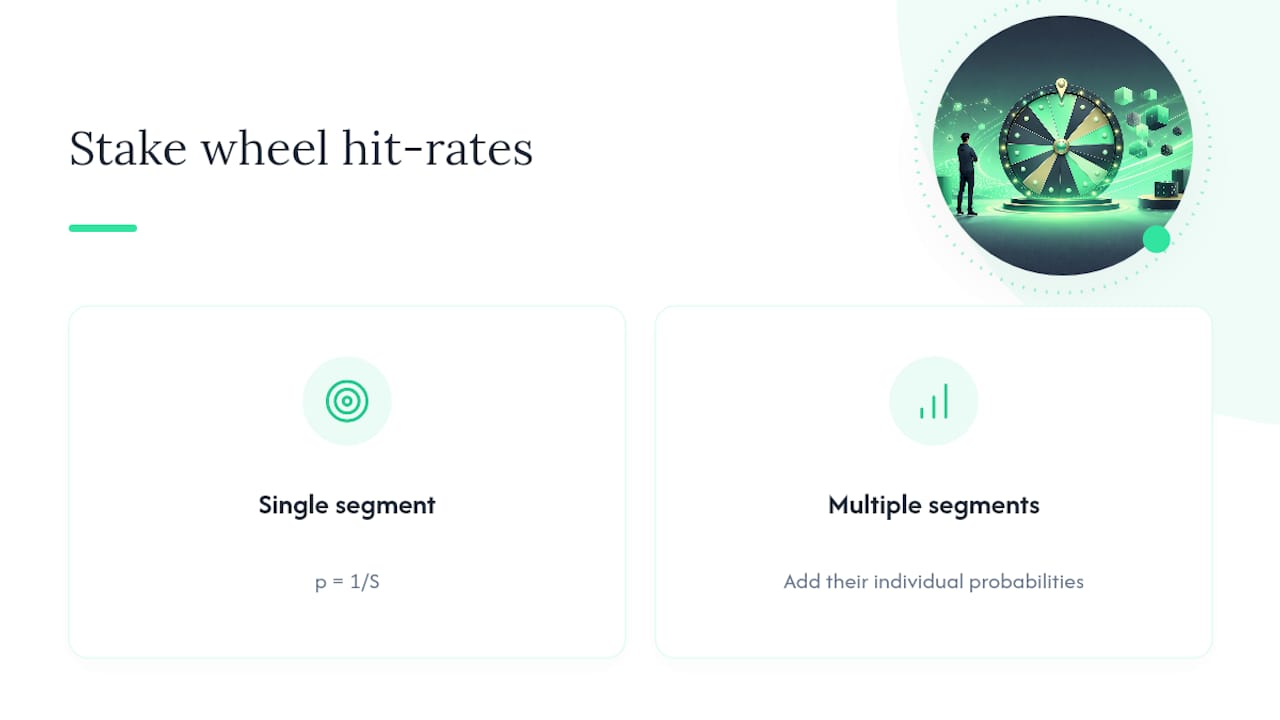
Hit-rate for a single winning segment is simply p = 1/S. For a profile where multiple segments share the same multiplier, add their individual probabilities.
The fair payout versus what the operator shows
A mathematically fair payout for a segment with hit-rate p would be M_fair = 1/p. At S=10, that is 10×. At S=50, that is 50×. The operator reduces this by the house edge to produce the displayed multiplier:
Moperator ≈ Mfair × (1 − house_edge)
The payout calculator at Stake Analyzer shows the full multiplier tables across all segment counts and risk tiers, confirming how operator multipliers are tuned to meet the ~99% RTP target.
Sample payout table (single winning segment, 1% house edge)
Worked example: You set S=50. The uniform float lands on one segment. Fair payout = 50×. Bet $1.00, win $49.50 on that segment. Over many spins, your expected return per dollar wagered is $0.99.
Short-term variance, especially on High risk settings, can produce results far above or below that figure across hundreds of spins.
How the provably-fair math produces your landing segment
Every Stake Wheel result is derived from three inputs: a server seed (hashed before the round, revealed after), a client seed (you can change it), and a nonce (increments with each bet). The process:
- Concatenate server seed + client seed + nonce.
- Run HMAC-SHA256 on that string.
- Take the first several bytes of the resulting hex hash.
- Convert those bytes to a decimal fraction to produce U, a uniform float in the range [0, 1).
- Apply segment_index = floor(U × S).
The ProvablySmart Wheel verifier documents each conversion step, including how to extract the correct byte range and perform the hex-to-float conversion.
Why S matters in the formula
Because U is uniform across [0, 1), multiplying by S and flooring creates S equal-width buckets. Segment 0 covers U in [0, 1/S), segment 1 covers [1/S, 2/S), and so on. Change S from 10 to 50 and the same U value lands in a completely different bucket. This is why the displayed segment count must match the S used in verification.
Worked example
Suppose U = 0.73 and S = 10. floor(0.73 × 10) = floor(7.3) = segment index 7
With S = 20: floor(0.73 × 20) = floor(14.6) = segment index 14
Same float, different game, different result. The ProvablySmart Wheel guide confirms this bucketing behavior and explains why the visible segment count is the critical input.
How to verify a Stake Wheel spin yourself
Verification is straightforward once you have the three seed values. Here is the full process:
- Export your game history. In your Stake account, navigate to the bet history for the Wheel round you want to check.
- Collect the three inputs. You need the revealed server seed (available after the round closes or after you rotate your client seed), your client seed, and the nonce for that specific bet.
- Run HMAC-SHA256. Use the StakeStats provably-fair explainer or the ProvablySmart verifier to compute the hash. Input: server seed as the key, "client seed:nonce" as the message.
- Convert to float U. Take the first 4 bytes of the hex output, convert to a 32-bit unsigned integer, divide by 2^32. That gives U in [0, 1).
- Compute segment_index = floor(U × S). Use the S value shown in the UI for that round.
- Cross-check. The computed index should match the segment that landed in the game. Confirm the multiplier at that index matches what was paid out.
Common pitfalls
- Using the wrong S (e.g., the default rather than the setting you actually played).
- Truncating the hash too early or using the wrong byte range.
- Comparing a pre-rotation server seed hash instead of the revealed post-rotation seed.
If your computed index consistently mismatches the displayed result, the ProvablySmart verifier includes a worked example you can use to check your conversion steps.
Pro Tip: Before rotating your client seed, save the round JSON from your bet history along with the exact multiplier array the UI displayed. Once you rotate, the old server seed is revealed and you can verify every spin from that session in one pass.
Quick verification checklist
- Revealed server seed confirmed (post-rotation)
- Client seed noted
- Nonce recorded for the specific bet
- HMAC-SHA256 computed correctly
- Byte range and hex-to-float conversion verified
- S matches the displayed segment count
- Computed index matches the landed segment and paid multiplier
Practical betting strategies and bankroll rules for each risk tier
Strategy cannot change expected value. The house edge is baked into the multipliers, and no bet-sizing system removes it. What strategy does control is variance: how wild the swings are and how long your bankroll survives a cold streak.

The Stake.us Wheel guide on Deadspin frames this clearly: Wheel is a chance-based game where play style shapes the session profile, not the outcome distribution over time.
Bet sizing by risk tier
Match your bet size to the volatility of your chosen setting. A rough guideline:
- Low risk (any S): bet up to 2–3% of your session bankroll per spin. Frequent small wins smooth the curve, but a long run of losses is still possible.
- Medium risk: keep bets at 1–2% of session bankroll. The multiplier spread is wider, so drawdowns last longer.
- High risk: no more than 0.5–1% per spin. A High risk, 50-segment wheel can produce 20–30 consecutive losses without being unusual. Size for that.
The Stake bankroll analyzer lets you model ruin probability against your chosen bet size and risk tier before you start.
Three play styles
Low-variance steady play uses Low risk with 10–20 segments. Hit frequency is high, swings are small, and sessions feel controlled. Suitable when you want extended play time on a fixed budget.
Medium-balance sessions use Medium risk with 20–30 segments. You get occasional mid-range hits that can recover a losing run, but you need a deeper bankroll buffer than Low risk requires.
High-variance chase uses High risk with 40–50 segments. The rare large multipliers are the draw. This is a short-session, defined-loss approach: set a hard stop-loss before you start and treat it as a fixed entertainment cost.
Session rules that matter
- Set a stop-loss at 30–40% of your session bankroll before the first spin.
- Set a stop-win at 50–100% profit. Walking away ahead is a choice, not a guarantee.
- Never increase bet size after a losing run to "catch up." The expected value per spin does not change; the ruin risk does.
Pro Tip: Auto and Instant Bet modes are useful for running a defined number of spins at a fixed stake, but they remove the natural pause between spins. If you find yourself extending the auto-run count mid-session, switch to manual. The pause is the control.
Common misconceptions about Stake Wheel odds
"High risk gives me better odds." It does not. Risk tier changes the multiplier distribution, not the probability of landing on any segment. Every segment remains equally likely regardless of tier. What High risk does is concentrate value into fewer, larger multipliers, which means more frequent zero-payout spins.
Short-term variance, especially on High risk settings, routinely produces sessions that look nothing like that number.
"I'm due for a win after a losing streak." Each spin is independent. The provably-fair system generates a fresh HMAC-SHA256 hash for every nonce. Past results carry no weight in the current calculation.
"Changing my client seed improves my luck." Rotating your client seed changes the sequence of future results, but since every outcome is uniformly distributed, no sequence is better or worse than another. The main reason to rotate is to reveal the previous server seed for verification.
"More segments means better payouts." More segments means rarer wins and proportionally larger multipliers on the winning segment. You are trading frequency for magnitude, not gaining edge.
Verification tools reduce one real source of anxiety: the fear that the game is not running as described. Running a check through the StakeStats provably-fair tools or the ProvablySmart verifier confirms the math is working correctly. That is a legitimate use of the tools. It does not, however, change the house edge or the variance of future spins.
Responsible gambling resources for U.S. players
Wheel is a fast game. Auto and Instant Bet modes make it faster. Before you play, set hard limits.
Quick checklist
- Set a deposit limit in your account settings before your first session.
- Decide your session budget and stop-loss before you open the game.
- Use self-exclusion tools if you find yourself playing beyond your limits.
- Never chase losses by increasing bet size or extending a session.
U.S. help resources
- National Problem Gambling Helpline: 1-800-522-4700, available 24/7 for call, text, or chat. Operated by the National Council on Problem Gambling.
- National Council on Problem Gambling (ncpgambling.org): Provides state-by-state resource directories and self-assessment tools.
- Gamblers Anonymous (gamblersanonymous.org): Peer support meetings available in most U.S. states, with online options.
- GambleAware (gambleaware.org): International resources and practical guidance on setting limits and recognizing problem gambling patterns.
Provably-fair verification confirms the game is running as advertised. It is a transparency tool, not a risk-management substitute. Knowing a spin was fair does not reduce the house edge or protect your bankroll.
Why verification tools change how you read your sessions
Running a provably-fair check on a Stake Wheel session is not just a trust exercise. It is genuinely diagnostic. When you pull the server seed, client seed, and nonce for a cold streak and confirm every spin was generated correctly, you shift from "was I cheated?" to "this is variance, and here is the math behind it." That reframe matters.
The StakeStats suite of Stake Engine tools goes further than single-spin verification. Realized RTP across a session, hit-rate by segment count, and volatility patterns across hundreds of rounds give you a data-backed picture of what actually happened versus what the theoretical model predicts. Most players who run that analysis come away with a clearer sense of how wide the variance band really is on High risk settings, which tends to recalibrate expectations more effectively than any strategy guide.
Stakestats does not change the math. What it does is make the math visible, which is the only honest basis for deciding how to play.
Stakestats gives you the tools to verify and analyze Wheel sessions
Most players accept the displayed result and move on. The ones who actually understand their sessions use tools that show the math behind every spin.
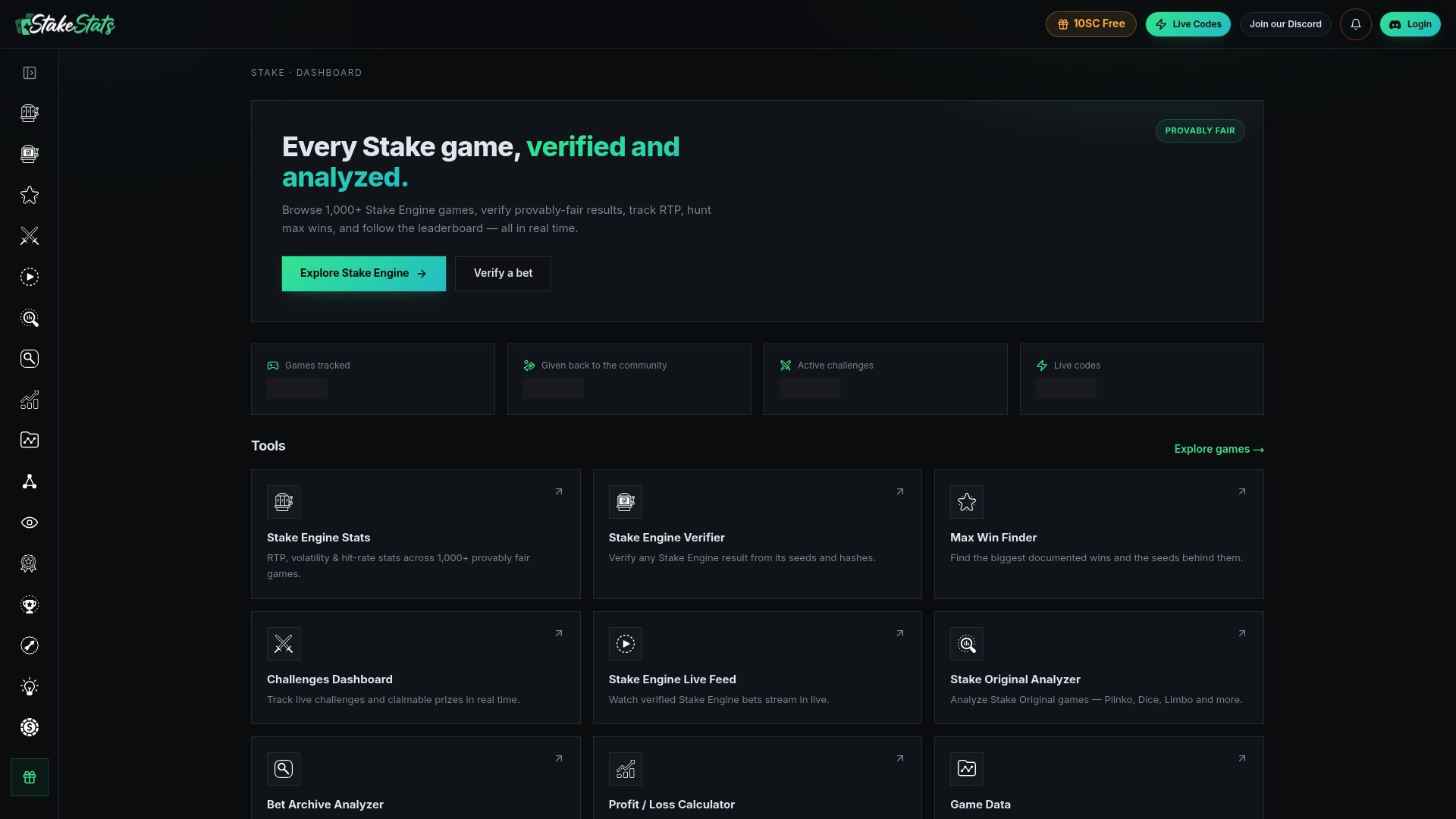
Stakestats maps directly onto the needs this article covers. The provably-fair verifier reproduces any Wheel spin from its server seed, client seed, and nonce, confirming the segment index matches what the game showed. The Stake Originals Analyzer tracks realized RTP and hit-rate across full sessions, so you can see whether your actual results align with the theoretical 99% over time. The bankroll analyzer models ruin probability for your chosen risk tier and bet size before you commit a dollar.
- Audit any spin: input three seed values, get the computed segment index in seconds.
- Track session RTP: compare realized returns against the 99% theoretical baseline across hundreds of rounds.
- Model your bankroll: enter your session budget, bet size, and risk tier to see expected drawdown ranges.
Head to the Stakestats transparency tools to verify your next Wheel session.
Sources
- Wheel - ProvablySmart
- How to play Wheel on Stake
- Stake.us Wheel: How to Play & Strategy for Stake Wheel
This article is general information about game mechanics and probability, not financial or gambling advice. Confirm current rules and available features with Stake directly, and contact a qualified professional or the resources above if gambling is causing harm.