
Why Gambling Is Not Investing: A Financial Guide

Gambling is defined as wagering money on uncertain, short-term outcomes where the house holds a mathematical edge, making it structurally different from investing. Understanding why gambling is not investing is one of the most practical lessons in financial literacy. Investing allocates capital to productive assets, generates ownership claims on future income, and compounds wealth over years or decades. Gambling does neither. The distinction matters because confusing the two leads to real financial harm, and the psychological traps that blur the line are more common than most people realize.
Why gambling is not investing: the core financial difference
Gambling is a negative expected return game by design. The house edge guarantees that, over enough bets, the player loses money. That is not a flaw in the system. It is the system.
Investing works on the opposite principle. Diversified, long-term investing historically favors the investor by tapping into the productive growth of real businesses and assets. A stock represents partial ownership of a company. A bond represents a loan that pays interest. Both create income and value over time.
The clearest way to see the difference is through the concept of ownership. Investing involves ownership claims on future cash flows such as dividends or interest. A gambling wager has no productive ownership stake. When you bet on a sports outcome, you own nothing. When you buy shares in a company, you own a piece of it.

Time horizon separates the two activities just as sharply. Investing requires a multi-year perspective to smooth out volatility. Gambling resolves in minutes or hours. That difference in time frame is not just logistical. It reflects a fundamentally different relationship with risk and reward.
How does gambling actually work financially?
Gambling mechanics are built around probability structures that favor the operator. Every casino game, sportsbook, and prediction market is calibrated so the house retains a percentage of every wager over time. This is called the house edge, and it makes gambling a mathematically losing proposition for the average participant.
The key financial characteristics of gambling are:
- All-or-nothing outcomes. A bet either wins or loses. There is no partial recovery, no residual value, and no income stream from the wager itself.
- No asset ownership. Placing a bet does not give you a stake in any business, property, or financial instrument.
- Short resolution windows. Outcomes settle in minutes or hours, which encourages repeated betting and accelerates losses.
- Negative expected value. The mathematical average outcome for a gambler is a loss, not a gain.
Casinos, sportsbooks, and online platforms all operate on this model. The entertainment value is real, but the financial outcome is predictable: the house wins over time.
Pro Tip: If you want to understand the true cost of gambling, calculate the house edge on your preferred game and multiply it by your average monthly wager. That number is your expected annual loss, not a worst-case scenario.
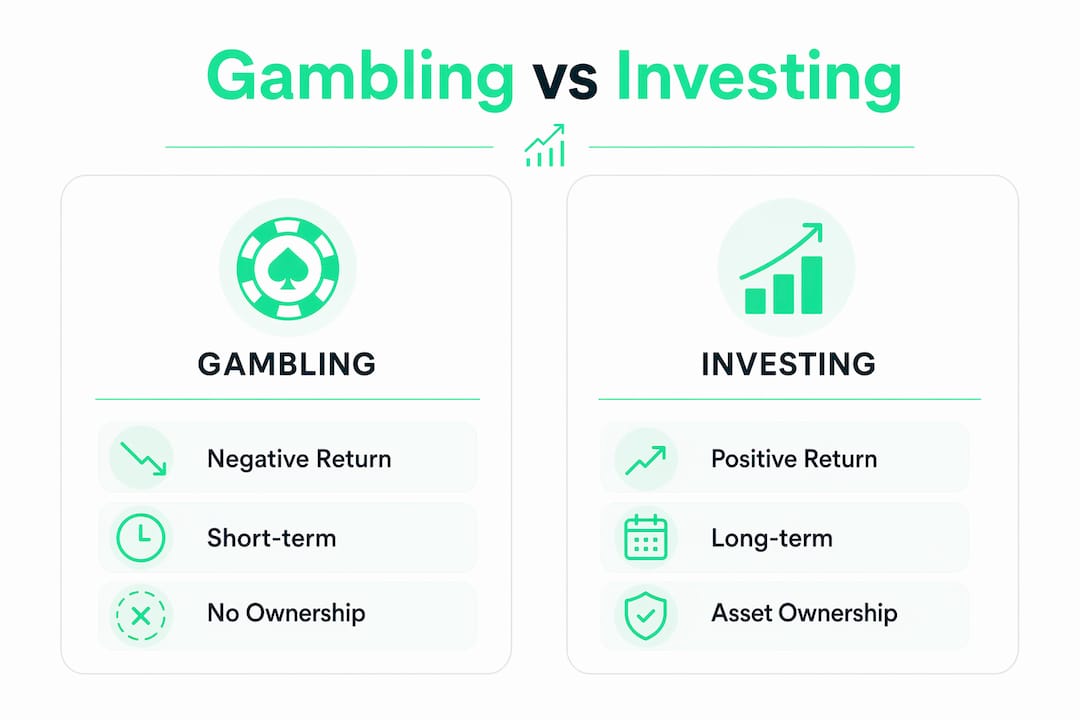
What makes investing fundamentally different?
Investing is the allocation of capital to productive assets with the expectation of generating income or appreciation over time. The key word is "productive." A business generates revenue. Real estate generates rent. A bond pays interest. These activities create new value, not just redistribute it.
The core features of investing that separate it from gambling are:
- Ownership. Buying a stock gives you a legal ownership stake in a company and a claim on its future earnings.
- Income generation. Dividends, interest, and rental income flow to investors regardless of whether they sell their position.
- Time horizon. Investors measure success over years or decades, not minutes. This longer view allows compounding to work.
- Partial recovery. Even when an investment performs poorly, it often retains residual value. A company's stock may fall 40% but still exist and recover.
"Investment failures often retain residual value allowing partial recovery, whereas gambling outcomes are usually all or nothing with zero recovery potential." AJ Bell
Compounding is the mechanism that makes investing genuinely wealth-building. When returns are reinvested, they generate their own returns. Over decades, this creates exponential growth that no gambling win can replicate, because gambling wins are terminal. They do not compound. They do not generate income. They sit in your pocket until the next bet.
The ability to reposition capital also matters. An investor who sees a sector declining can shift funds into a different asset class. A gambler who loses a bet has no position to reposition. The money is gone.
What are the psychological differences between gambling and investing?
The psychological profiles of gambling and investing are distinct, but the line between them can blur in practice. Gambling triggers dopamine responses tied to reward uncertainty. The brain releases dopamine not just when you win, but when the outcome is unpredictable. That neurological response is the same mechanism behind addiction.
Investing, done correctly, is driven by research, patience, and rational risk analysis. The emotional experience is quieter. A disciplined investor checks portfolio performance quarterly, not hourly. The goal is steady, compounding growth, not an adrenaline spike.
The psychological risks of gambling include:
- Loss chasing. After a loss, the impulse to bet again to recover is a hallmark of gambling behavior, not investing strategy.
- Emotional highs and lows. Gambling produces intense short-term emotional swings that investing does not replicate in healthy practice.
- Addiction potential. The transition from investing to gambling behavior is often marked by chasing emotional highs and loss of control.
Modern financial apps complicate this picture. 24/7 rapid price fluctuations on trading platforms mimic casino uncertainty, increasing the risk of investors slipping into gambling behavior. Day trading individual stocks with no research, chasing meme coins, and reacting to every market move are investing activities that function psychologically like gambling.
Pro Tip: If you feel a rush of excitement when placing a trade, pause. That emotional response is a signal to slow down and check whether your decision is based on research or impulse.
Does gambling displace capital that could build long-term wealth?
The economic cost of gambling extends beyond individual losses. For every $1.00 spent on sports betting, net investment in equities and financial instruments decreases by more than $2.00. That figure reveals gambling's role as a capital sink, not just a personal expense.
Capital that flows into gambling is removed from the productive economy. It does not fund businesses, generate employment, or create compounding returns. Gambling's capital sink effect removes wealth from economic circulation, whereas investing recycles capital into productive assets that generate income and growth.
| Factor | Gambling | Investing |
|---|---|---|
| Expected return | Negative (house edge) | Positive over long term |
| Ownership | None | Equity, debt, or property stake |
| Time horizon | Minutes to hours | Years to decades |
| Recovery potential | Zero (all or nothing) | Partial residual value often remains |
| Capital effect | Removed from economy | Recycled into productive assets |
The opportunity cost of gambling is compounding. Every dollar lost to a bet is a dollar that cannot grow. A $200 monthly gambling loss, invested instead over 20 years at a historical average equity return, would grow into a substantial sum. The gambling version of that money is simply gone.
Personal financial security is the most direct casualty. Gamblers who treat betting as a financial strategy consistently underperform investors who apply even basic discipline. The math is not close.
How can you tell if a financial activity is gambling, not investing?
Recognizing gambling behavior in financial activities is a practical skill. The following signs indicate that a financial activity has crossed from investing into gambling:
- No research basis. If you cannot explain why you made a financial decision beyond "I had a feeling," it is a bet, not an investment.
- Short time horizon. If you expect to profit within hours or days, you are speculating, not investing.
- All-or-nothing framing. If losing your position means losing everything with no recovery path, the structure resembles gambling.
- Emotional decision-making. If fear or excitement drives your choices rather than analysis, the behavior pattern matches gambling.
- Chasing losses. Increasing position size after a loss to recover quickly is a gambling response, not an investment strategy.
Improving financial literacy is the most effective defense against these patterns. Reading foundational texts on investing, understanding how compound interest works, and setting a written investment plan before placing any capital all reduce impulsive behavior. Long-term discipline is not glamorous, but it is the mechanism behind every durable wealth outcome.
Key Takeaways
Gambling is a negative expected return activity with no ownership stake, while investing allocates capital to productive assets that generate income and compound wealth over time.
| Point | Details |
|---|---|
| Ownership is the core divide | Investing gives you an asset stake; gambling gives you nothing but a wager outcome. |
| House edge makes gambling a losing system | Every gambling structure is designed so the operator profits over time, not the player. |
| Psychology drives the confusion | Dopamine responses to rapid trading mimic gambling addiction, blurring the behavioral line. |
| Gambling displaces investment capital | Each dollar lost to betting reduces equity investment by more than $2.00 in aggregate. |
| Time horizon is the practical test | Investing measures success in years; gambling resolves in hours with no compounding effect. |
The line I've watched people cross without realizing it
I've spent years watching people describe their betting activity as "investing in outcomes" or their day trading as "just playing the market." The language is telling. When someone uses investing vocabulary to describe gambling behavior, they are usually trying to justify an emotional decision with rational framing.
The most dangerous version of this is high-frequency trading with no research basis. The brain's dopamine response to reward uncertainty in rapid trading is neurologically identical to gambling addiction. People genuinely believe they are being strategic when they are actually chasing a chemical response.
What I've found actually separates disciplined investors from disguised gamblers is their relationship with boredom. Real investing is boring. You buy a diversified position, you wait, you reinvest dividends, and you do not check the price every hour. If your financial activity requires constant attention and produces emotional highs, it is not investing. It is gambling with extra steps.
The practical advice I give is simple: write down your investment thesis before you commit capital. If you cannot write three sentences explaining why an asset will be worth more in five years, you are not investing. You are betting. That one habit eliminates most impulsive financial decisions before they happen.
— Ian
Stakestats: transparency for informed financial decisions
Knowing the difference between gambling and investing is the first step. Knowing exactly what your gambling activity looks like in numbers is the second.

Stakestats provides transparency and utility for online gamblers who use Stake.com and other provably fair platforms. If you engage in online gambling and want a clear view of your activity, patterns, and outcomes, Stakestats gives you the data to make informed decisions. Understanding your actual results, rather than relying on memory or emotion, is the foundation of any responsible approach to gambling. Visit stakestats.net to see what your numbers actually say.
FAQ
What is the main difference between gambling and investing?
Investing involves ownership of productive assets that generate income and appreciate over time. Gambling is a wager on a short-term outcome with no ownership stake and a negative expected return by design.
Is day trading considered gambling?
Day trading without a research basis functions psychologically and financially like gambling. The brain's dopamine response to rapid price fluctuations mirrors gambling addiction, and short time horizons eliminate the compounding benefit that defines investing.
Can gambling ever be a financial strategy?
Gambling cannot serve as a long-term financial strategy because the house edge guarantees a negative expected return over time. No betting system overcomes a structural mathematical disadvantage built into every game.
Why does gambling hurt long-term wealth more than just the money lost?
For every $1.00 spent on sports betting, equity investment decreases by more than $2.00 in aggregate. The lost compounding on that displaced capital represents a far larger long-term cost than the face value of the wager.
How do I know if my investing behavior has become gambling?
If your decisions are driven by emotion rather than research, your time horizon is hours rather than years, and you are chasing losses to recover quickly, your behavior matches gambling patterns rather than investing discipline.