
Why Gambling Odds Favor the House: A Crypto Player's Guide

Casinos and provably-fair crypto platforms don't win because they're lucky. They win because every game is mathematically structured so that payout odds fall below true probabilities. That gap, called the house edge, guarantees the operator a predictable profit across millions of bets regardless of who wins on any given night. The law of large numbers makes results converge toward that expectation over time, so the longer you play, the more your bankroll reflects the math. For provably-fair crypto players, tools like Stakestats translate that math into session-level bankroll projections you can actually use.
Key facts up front:
- House edge ranges from low in optimized blackjack to very high in keno and some slots
- Return to Player (RTP) = 100% minus house edge; a 96% RTP slot carries a 4% edge
- Provably-fair verification confirms randomness, not favorable payout odds
- Stakestats's bankroll analyzer models time-to-ruin under your exact edge and bet-frequency inputs
Table of Contents
- Why gambling odds favor the house: the math behind the edge
- Which games cost you the least (and the most)?
- Why repeated play locks in the house's advantage
- Common misconceptions that cost players money
- Practical steps to reduce your expected losses
- What provably fair actually proves (and what it doesn't)
- Worked examples: what house edge costs over real sessions
- Key Takeaways
- The math doesn't lie, but it does get misread
- Stakestats gives you the tools to play with clear eyes
- Useful sources and further reading
Why gambling odds favor the house: the math behind the edge
The house edge is the percentage of every bet the casino expects to keep, averaged across an enormous number of identical bets. It is not a per-bet fee deducted from your wallet. It lives inside the payout structure itself.
The relationship is simple: RTP = 100% − house edge. A game with a 2% house edge returns 98% of all money wagered to players over time and keeps 2%. The formula for expected loss on any session is equally direct:
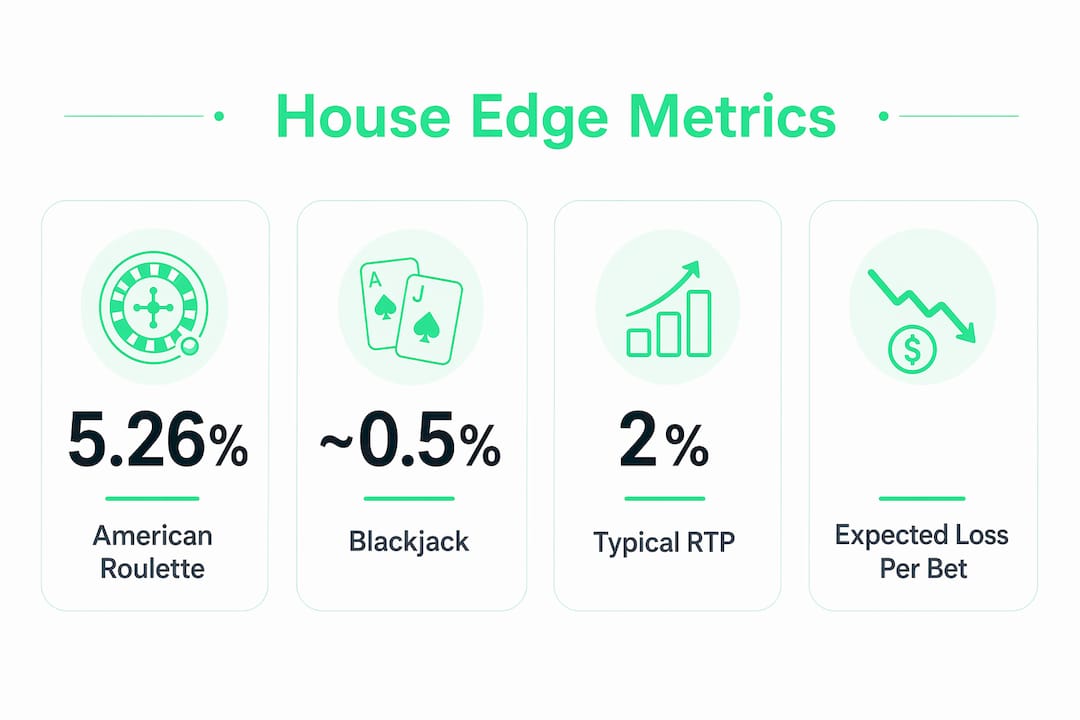
American roulette makes the mechanism concrete. There are 38 pockets, so the true odds of hitting a single number are 37-to-1 against you. The casino pays 35-to-1. Thirty-eight players each bet $1 on a different number; the house collects $38, pays out $35, and pockets $3. That $3 profit on $38 wagered is a 5.26% house edge. No one charged a commission. The underpayment is the edge.
One nuance worth knowing: for games that require multiple or conditional bets (certain poker variants, Caribbean stud), the headline house-edge percentage can distort comparisons. Money lost divided by total money wagered gives a cleaner picture of true risk in those cases.
| Metric | What it measures | Example |
|---|---|---|
| House edge | % of each bet the casino keeps long-run | 5.26% on American roulette |
| RTP | % returned to players long-run | 94.74% on American roulette |
| Expected loss | Stake × edge × bets | $10 × 2% × 50 = $10 expected loss |
Which games cost you the least (and the most)?
House edge varies enormously by game, and that variation is almost entirely within your control through game selection.
| Game | Typical house edge | Key note |
|---|---|---|
| Blackjack (basic strategy) | ~0.5% | Requires learning optimal play |
| Baccarat (banker bet) | ~1.06% | No strategy required |
| Single-zero roulette | ~2.7% | Fixed regardless of bet type |
| American roulette | ~5.26% | Double-zero adds ~2.5% cost |
| Slots | 4%–15%+ | RTP varies widely by title |
| Keno | 15–40%+ | Among the highest edges available |

Blackjack's 0.5% edge assumes you apply basic strategy consistently. A player making intuitive decisions at the same table faces closer to 2–4%. The skill gap translates directly into dollars: at $10 a hand, the difference between 0.5% and 4% is roughly $35 per 100 hands.
Why repeated play locks in the house's advantage
Expected value (EV) is the average outcome of a bet repeated infinitely. For any negative-EV game, EV is negative by definition. The law of large numbers is what makes that expectation real: as the number of independent bets grows, actual results converge toward the mathematical average.
Short-term variance is what fools players. In 50 spins of roulette, you can easily be up $200 or down $400. Neither result tells you anything useful about the house edge. The sample is too small for the long-run average to dominate. High-variance games (volatile slots, long-shot bets) produce bigger swings in both directions, which creates the illusion that the edge is beatable.
"Even a small bias combined with an unlimited house bankroll makes player ruin probable over long sequences of bets." — The Conversation
This is gambler's ruin in practice: the house has an effectively infinite bankroll; you don't. A small persistent edge plus that asymmetry makes long-term ruin mathematically likely for any finite player bankroll.
Pro Tip: Slowing your bet pace is one of the most underrated levers you have. Expected loss scales with total bets placed, not time spent. Fewer bets per hour means less total exposure to the edge, regardless of which game you're playing.
Common misconceptions that cost players money
Most losing strategies share a root cause: confusing short-term variance with a change in the underlying edge.
- Gambler's fallacy: Believing a "due" outcome is more likely after a losing streak. Each bet is statistically independent. The wheel has no memory.
- Hot streaks: Winning runs are variance, not evidence the edge has flipped. The edge on the next bet is identical to the edge on the first.
- Staking systems (Martingale, Paroli, etc.): These change risk concentration but cannot alter per-bet expected value. Martingale hits table limits before it can recover a deep losing streak, and the bankroll required to survive a bad run grows exponentially.
- RTP as a session guarantee: A 96% RTP slot does not return $96 of every $100 you personally wager in one session. That figure is a long-run average across all players and all spins.
Card counting in regulated brick-and-mortar blackjack is a genuine exception, but it requires specific rule conditions, physical deck penetration, and a casino that hasn't banned you. It has zero application to RNG-based provably-fair games.
Practical steps to reduce your expected losses
You can't eliminate the edge, but you can shrink it and slow its effect on your bankroll.
- Choose the lowest-edge game you enjoy. Blackjack with basic strategy or baccarat banker bets cost a fraction of what slots or keno do per dollar wagered.
- Learn basic strategy for blackjack. A few hours of study cuts the edge from ~2–4% to ~0.5%.
- Set a session loss limit before you start. Decide the maximum you'll lose and stop there, regardless of how the session feels.
- Size bets as a fixed percentage of your session bankroll. Flat betting at 1–2% of your session stake extends play and limits ruin risk.
- Slow your bet frequency. Expected loss scales directly with total bets placed. Fewer spins per hour means less edge exposure per hour.
- Avoid high-edge bonus traps. Wagering requirements often steer players toward higher-edge games during play-through. Check game weighting before accepting a bonus.
Pro Tip: Use the Stakestats bankroll analyzer to input your house edge, bet size, and bets-per-hour rate. It shows you the expected loss curve and time-to-ruin before you sit down, not after.
What provably fair actually proves (and what it doesn't)
Provably-fair mechanics verify that the RNG outcome was not manipulated after you placed your bet. That is genuinely valuable. What it does not verify is whether the payout structure favors you. The house edge still lives in the payout rules, not in the randomness of the outcome.
Verification steps for any provably-fair game:
- Before play, record the server seed hash the platform publishes.
- After play, retrieve the revealed server seed and your client seed.
- Run the combined hash through the platform's verification tool or an independent checker.
- Confirm the outcome matches. Then separately check the game's payout table against true probabilities to calculate the actual house edge.
Stakestats's provably-fair explanation tool walks through each step and the transparency page documents payout rules for Stake Engine games so you can confirm the edge independently.
Worked examples: what house edge costs over real sessions
These three scenarios use the formula: expected loss = stake × house edge × number of bets.
| Scenario | Stake | Edge | Bets/hr | Expected loss: 1 hr | Expected loss: 10 hrs | Expected loss: 100 hrs |
|---|---|---|---|---|---|---|
| Low-edge steady play (blackjack, basic strategy) | $10 | 0.5% | 60 | $3 | $30 | $300 |
| Medium-edge fast online play (single-zero roulette) | $10 | 2.7% | 120 | $32.40 | $324 | $3,240 |
| High-edge slot-style play | $5 | 10% | 600 | $300 | $3,000 | $30,000 |
Variance means any single session can deviate sharply from these figures. The slot scenario's $300 expected hourly loss could look like a $1,000 win or a $2,000 loss in one sitting. Over 100 hours, results converge hard toward the math. The pace difference between 60 bets per hour and 600 is the single biggest driver of that gap, not the edge percentage alone.
Key Takeaways
The house edge is a permanent, built-in mathematical cost that grows with every bet you place, and choosing lower-edge games combined with slower play is the most effective way to extend your bankroll.
| Point | Details |
|---|---|
| Edge lives in payout rules | Casinos pay less than true probability warrants; that gap is the house edge, not a fee. |
| Game selection matters most | Blackjack at ~0.5% costs a fraction of slots at 10%+ per dollar wagered over time. |
| Pace multiplies exposure | Expected loss = stake × edge × bets; cutting bets per hour directly cuts expected loss per hour. |
| Provably fair ≠ player-favorable odds | Randomness verification and payout fairness are separate checks; always confirm both. |
| Stakestats models your real risk | The bankroll analyzer and profit/loss tools translate house-edge inputs into session-level loss projections. |
The math doesn't lie, but it does get misread
The most persistent mistake I see among crypto gamblers isn't ignoring the house edge. It's treating a winning session as evidence the edge doesn't apply to them. Variance is generous in the short run precisely because it has to be. If players lost predictably every session, nobody would play. The occasional big win is the mechanism that keeps the edge invisible until it isn't.
What changes when you understand the math is how you frame the activity. A $300 expected loss over 100 hours of blackjack at $10 a hand is $3 an hour for entertainment. That's a reasonable price. A $300 expected loss in a single hour of high-pace slot play is a different proposition entirely. The edge percentage looks similar on paper. The pace is what makes them incomparable in practice.
Provably-fair verification adds one layer of genuine protection: you know the outcome wasn't rigged after the fact. But it doesn't change the payout math. Run the verification steps, then check the payout table. Both checks take two minutes and together they tell you everything you need to know before you bet.
Stakestats gives you the tools to play with clear eyes
Most crypto gamblers know the house has an edge. Far fewer know their exact expected loss per hour, or whether the provably-fair game they're playing has been independently verified. Stakestats closes that gap.

The bankroll analyzer lets you input your game's house edge, bet size, and pace to see projected loss curves before your session starts. The provably-fair explanation tool walks you through seed verification step by step. The transparency pages document payout rules for Stake Engine games so you can confirm the edge yourself, not take the platform's word for it. And the bonus tools flag when wagering requirements are routing you toward higher-edge games during play-through.
Head to Stakestats and run your numbers before your next session.
Useful sources and further reading
"Understanding the house edge won't make you a winner. What it will do is make you a more informed player: someone who chooses games with clear eyes, applies skill where skill genuinely matters, and knows exactly what they're paying for." — SkillsGambling
- House edge explained — Blackjack Guide
- House edge of casino games compared — Wizard of Odds
- Why casino gamblers lose more than the house edge — Medium
- Why does the house always win? — Investopedia
- Gambler's fallacy — Wikipedia
- Stakestats provably-fair explanation tool
- Stakestats bankroll analyzer
This article is general information about gambling mathematics, not financial or legal advice. Gambling laws and platform availability vary by jurisdiction; confirm the rules that apply to your situation before playing.