
Why Games Mimic Gambling Mechanics: The Psychology Behind It

Video games mimic gambling mechanics because unpredictable reward systems, specifically variable ratio reinforcement schedules, produce the most compulsive and difficult-to-break engagement patterns known in behavioral psychology. Game designers have borrowed these principles directly from gambling research to maximize playtime and spending. The result is a design overlap so deliberate that regulators, researchers, and players are now asking the same question: where does a game end and a gamble begin? Understanding why games use gambling elements is no longer just an academic exercise. It has real consequences for how you spend your time and money.
Why games mimic gambling mechanics: the core psychological engine
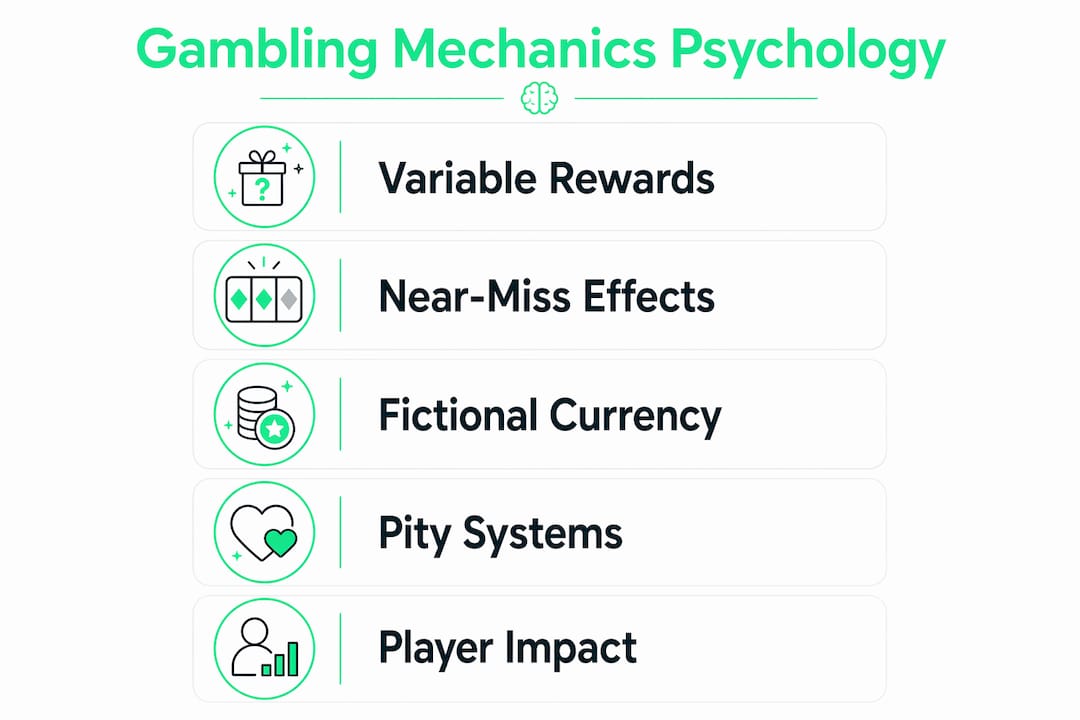
Variable ratio reinforcement is the single most powerful reward schedule ever studied. It rewards behavior after an unpredictable number of attempts, which is exactly how slot machines and loot boxes both work. Variable ratio schedules are intentionally designed into gacha and loot box systems to maximize playtime, because the unpredictability prevents players from ever feeling "done." A fixed reward, like earning a coin every ten kills, is easy to walk away from. A random reward keeps you pulling the lever one more time.
The similarities between games and gambling run deeper than just reward timing. Both systems use audiovisual feedback loops, fictional currencies, and near-miss animations to sustain engagement. These are not accidental design choices. They are the product of decades of behavioral psychology research applied to monetization.

Near-miss effects and fictional currencies
Near-miss feedback is one of the most studied phenomena in gambling psychology. Near-miss events in loot boxes are deliberately engineered using asymmetric presentation layers that mimic slot machine reels, triggering brain reward areas and increasing the urge to keep playing. The player almost got the rare item. That "almost" feels meaningful, even though the outcome was statistically predetermined.
Fictional currencies, like gems, coins, or tokens, serve a specific psychological function. They create a buffer between real money and perceived spending. When you spend 1,200 gems instead of $9.99, the transaction feels abstract. That abstraction reduces spending resistance and increases total expenditure over time.
Pro Tip: If a game asks you to convert real money into a proprietary currency before spending, treat that conversion step as a deliberate friction reducer. Calculate the real-dollar cost of every in-game purchase before you make it.
The mechanics most commonly embedded in games include:
- Variable ratio reinforcement: Rewards arrive on an unpredictable schedule, sustaining engagement indefinitely.
- Near-miss animations: Visual feedback that makes a failed attempt feel close to success, encouraging another try.
- Fictional currencies: In-game tokens that obscure the real cost of purchases.
- Pity systems: Guaranteed reward after a set number of failed pulls, which exploit the sunk cost fallacy by setting a minimum spend floor.
- FOMO triggers: Limited-time offers and rotating item pools that pressure immediate spending.
What does the research say about loot boxes and player behavior?
The empirical evidence linking gambling game mechanics to real harm is now substantial. A 2026 national study of 3,709 participants found that over half of regular gamblers who play video games reported purchasing loot boxes, with loot box frequency and spending directly tied to increased problem gambling severity. That finding means the overlap between gaming and gambling is not theoretical. It shows up in measurable harm.
A separate 2026 survey of 1,358 Polish gamers with a mean age of 34.56 found that risky loot box use correlates positively with both frequency and expenditure. Notably, women scored higher in risky usage patterns than men in that sample. The motivators driving sustained engagement included achievement, escapism, and social rewards, which are the same psychological needs that gambling operators have targeted for decades.
| Research finding | Sample | Key result |
|---|---|---|
| Loot box purchases and problem gambling severity | 3,709 participants, mostly male, avg. age 38.7 | Over half of regular gamblers who game reported loot box purchases tied to harm |
| Risky loot box use and correlates | 1,358 Polish gamers, mean age 34.56 | Risky use correlates with frequency and spend; women showed higher risky use |
| Motivations behind gambling-like features | Australians aged 18–24, 2026 | Social engagement drives initial use; financial and psychological rewards sustain it |
Qualitative research on Australians aged 18–24 adds important nuance. Young adults initially engage with gambling-like features socially, drawn in by shared experiences with friends. Sustained engagement then depends on a mix of social, psychological, and financial rewards. That progression mirrors how problem gambling typically develops: casual participation first, then reinforcement, then dependency.
The psychology of gambling in games is not a side effect of poor design. The research consistently shows it is the intended outcome of deliberate design choices built to sustain engagement and spending.
How do game designers deliberately build gambling mechanics into games?
Game designers do not stumble into addictive game design strategies. They apply them intentionally. FOMO, loss aversion, and near-miss effects are embedded design elements used to shape player spending decisions, according to a 2026 typology study by Ivern, Carbonell, and Griffiths. These are not bugs. They are features.
The deliberate integration of gambling mechanics follows a recognizable pattern:
- Introduce variable rewards early. The first loot box a player opens is often seeded with a high-value item. This establishes the expectation of reward and anchors the player to the system.
- Apply artificial time pressure. Limited-time banners, seasonal events, and rotating item pools create urgency. The player feels they must spend now or lose access forever.
- Use social status as a motivator. Rare cosmetic items signal status within the game's community. Spending becomes a social act, not just a personal one.
- Engineer near-miss feedback. Reel animations, spinning wheels, and opening sequences are designed to show near-wins. Game design intentionally blurs the line between casinos and video games by transferring these elements directly from slot machine design.
- Deploy pity systems as spend floors. A pity system guarantees a rare item after a fixed number of failed pulls. This sounds protective, but it functions as a minimum spend commitment. Once a player has invested 80 pulls without the desired item, the sunk cost of stopping feels greater than the cost of continuing.
Pro Tip: Track your pull count in any gacha system before you start spending. Knowing exactly how far you are from a pity threshold tells you the real minimum cost of the item you want, not the advertised probability.
Return to Player percentages, the long-term payout averages used in slot design, are a separate tool from volatility, which controls the emotional pacing of a session. Game developers use RTP and volatility separately to engineer emotional highs and lows within a play session. That same architecture now appears in video game reward systems, pacing wins and losses to sustain engagement without triggering dropout.
What are the implications of gambling mechanics in games for players?
The behavioral risks tied to the impact of gambling in gaming are not limited to problem gamblers. Any player engaging with loot box systems is exposed to the same psychological mechanisms that make gambling addictive. The difference is that video games often lack the regulatory guardrails that govern licensed gambling operators.
Key risks and concerns include:
- Problem gambling crossover. The 2026 national study found a direct link between loot box spending and problem gambling severity, suggesting these systems can accelerate existing vulnerabilities.
- Targeting of younger players. Many games featuring loot boxes carry age ratings that do not reflect the gambling-like nature of their monetization. Age verification for in-game purchases remains inconsistent across platforms.
- Spending without transparency. Drop rates for rare items are not always disclosed. Players often spend without knowing the true probability of the reward they are chasing.
- Erosion of player trust. As industry debate around responsible visibility grows, players are becoming more aware of these mechanics. That awareness is beginning to affect how they evaluate games before purchasing.
- Regulatory gaps. Most jurisdictions do not classify loot boxes as gambling, which means consumer protections that apply to casinos do not apply to games. Spending limits, mandatory disclosures, and self-exclusion tools are largely absent.
Responsible design does exist. Some developers now publish drop rates, cap daily spending, and offer direct purchase options for desired items. These practices reduce the predatory edge of gambling game mechanics without eliminating the engagement they create.
Key Takeaways
Games mimic gambling mechanics because variable ratio reinforcement, near-miss effects, and sunk cost systems are the most effective psychological tools for sustaining engagement and spending ever identified.
| Point | Details |
|---|---|
| Variable ratio reinforcement | Unpredictable rewards create the strongest compulsive behavior patterns in both gambling and gaming. |
| Near-miss engineering | Loot box animations mimic slot machines deliberately, triggering reward responses that increase the urge to continue. |
| Pity systems as spend floors | Guaranteed rewards after failed pulls exploit sunk cost psychology, not player protection. |
| Research confirms real harm | A 2026 study of 3,709 participants linked loot box spending directly to increased problem gambling severity. |
| Regulatory gaps persist | Most jurisdictions do not classify loot boxes as gambling, leaving players without standard consumer protections. |
The line between entertainment and exploitation is thinner than the industry admits
I have spent years watching the conversation around gambling mechanics in games shift from niche academic concern to mainstream regulatory debate. What strikes me most is how slowly the industry has moved, given how clearly the research points in one direction.
The argument that loot boxes are "just cosmetic" or "just for fun" collapses the moment you look at the design documentation. Variable ratio reinforcement, near-miss feedback, and pity systems are not cosmetic choices. They are monetization architecture. The fact that the reward is a character skin instead of cash does not change the psychological mechanism driving the purchase.
What I find genuinely encouraging is the growing pressure for transparency. Players who understand provably fair verification and drop rate disclosure are harder to exploit. Education is the fastest path to accountability, because regulation moves slowly and design incentives do not self-correct.
The industry will not voluntarily abandon mechanics that generate significant revenue. But players who understand the psychology behind these systems can make genuinely informed choices. That knowledge gap is the real problem, and closing it matters more than any single regulatory ruling.
— Ian
Stakestats tools for understanding gambling mechanics in games
Players who want to move from awareness to analysis have practical options. Stakestats provides transparency and utility for players engaging with provably fair systems, giving you the data to evaluate whether a game's reward mechanics are operating as advertised.

The provably fair verification tools at Stakestats let you check whether outcomes are genuinely random or engineered against you. The bankroll analyzer helps you track spending patterns over time, which is the single most effective way to recognize when a reward system is shaping your behavior rather than rewarding your skill. When the mechanics are visible, the psychology loses its grip.
FAQ
What is variable ratio reinforcement in games?
Variable ratio reinforcement is a reward schedule that delivers outcomes after an unpredictable number of attempts. It is the core mechanism behind both slot machines and loot box systems, and it produces the most compulsive engagement patterns of any reward structure.
Are loot boxes considered gambling?
Most jurisdictions do not legally classify loot boxes as gambling, which means standard consumer protections do not apply. A 2026 national study of 3,709 participants found direct links between loot box spending and problem gambling severity, fueling ongoing regulatory debate.
Why do games use fictional currencies instead of real money?
Fictional currencies reduce spending resistance by creating psychological distance between the player and the real cost of a purchase. Converting dollars into gems or tokens makes each transaction feel abstract, which consistently increases total spending.
What is a pity system and why is it problematic?
A pity system guarantees a rare item after a set number of failed pulls. While marketed as player-friendly, it functions as a minimum spend floor by exploiting the sunk cost fallacy, encouraging players to continue spending after prior investment.
How can players protect themselves from addictive game design strategies?
Tracking pull counts, calculating real-dollar costs of fictional currency purchases, and using tools like the Stakestats bankroll analyzer to monitor spending patterns are the most direct ways to stay aware of how reward systems are influencing your behavior.