
Win Goal Setting: How to Set a Win Target Before You Play

A win goal is a number you pick before a session that tells you when to cash out and close the tab. It only works as part of a three-part plan: a loss limit, a time cap and a win target, all written down before the first bet. Set it from your own bankroll and the game's math, not from how the session feels, and track it afterward so the next target is based on results instead of hope.
This guide is for adults who play online, including crypto and provably fair games. It covers how to size each limit, what to do when you hit the target, and how to measure whether your goals are realistic.
TL;DR
- Set three numbers before you play: a loss limit, a time cap and a win target. The loss limit comes first.
- Keep bets small and flat, around 1% to 2% of your bankroll per bet, so one bad run cannot end your session early.
- A win target does not change the odds. Every bet carries the same house edge whether you are ahead or behind.
- Provably fair verification confirms a result followed the game's inputs and math. It does not guarantee a win.
- Log the plan and the outcome for each session, then adjust the targets from your own data.
Table of Contents
- What a win goal is, and what it is not
- Start with the loss limit, then add the win target
- A worked example: one session, three numbers
- Pick the numbers from math, not mood
- What provably fair verification does for your goals
- When you hit the win target
- Why a bigger win target does not mean better odds
- Track every session, then adjust
- Goals that do not depend on winning
- Build your session plan with Stakestats
- FAQ
- Sources
What a win goal is, and what it is not
Most goal-setting advice online is about careers and fitness: be specific, be measurable, set a deadline. The same logic applies at the table or the slot, with one twist. In gambling, the outcome is not something your effort controls. You control the inputs: how much you risk, how long you play and when you leave.
That is why a good win goal is a rule about leaving, not a prediction about winning. "I will stop when I am up $50" is a goal you can fully carry out. "I will win $500 today" is a hope, because no amount of discipline makes the game pay that out.
The responsible gambling bodies in the US frame it the same way. The Oregon Council on Problem Gambling's guidelines for a healthy relationship with gambling say to treat gambling as entertainment rather than a way to make money, set a spending limit in advance and stick to it, use only money you can afford to spend, avoid chasing losses, and set a time limit with regular breaks. The National Council on Problem Gambling gives the same core advice: set time and money limits before any bet, stop when you reach them and never chase losses.
A win target fits inside that frame as one of the exit rules.
Start with the loss limit, then add the win target
Players usually write the win target first because it is the fun number. Do it in the opposite order.
- Bankroll. The total money you have set aside for gambling, money you can afford to spend.
- Session roll. The slice of that bankroll you bring to one session. This is also your loss limit.
- Bet size. A flat amount that lets the session roll last long enough to be worth playing.
- Time cap. How long you will play before a break or a stop.
- Win target. The profit at which you leave or lock in part of it.
There is no single correct ratio, but there are published reference points. GameSense, the responsible gambling program of the Alberta Gaming, Liquor and Cannabis Commission, suggests capping your gambling budget at 1% to 5% of disposable income, for example $20 to $40 out of a $400 leisure budget. It also recommends a double-limit approach, such as playing for one hour and stopping if you lose $50 or win $75. That program is Canadian, but the arithmetic works for any player.
For bet size, our own guides use 1% to 2% units. The reasoning, with resizing rules, is in bankroll management with 1% to 2% units. If you want the whole routine in one place, the 5-step session plan for recreational casino bankroll management walks through it.
A worked example: one session, three numbers
Here is an illustration with round numbers. It is a template, not a promise about results.
- Bankroll: $1,000
- Session roll and loss limit: $100
- Flat bet: $2 (so the session roll covers 50 bets at minimum)
- Time cap: 60 minutes
- Win target: +$50
The rule you write down: "I play $2 bets for up to 60 minutes. I stop if I am down $100, up $50, or the hour ends, whichever comes first."
Notice three things.
The loss limit is bigger than the win target. That is normal. Most games are built so that small wins are frequent and a big swing is rare, so you will hit the time cap more often than either limit.
The house edge still runs. Suppose the game has a 97% return to player (RTP, the share of wagers a game pays back on average over a very large number of bets). If you place 400 bets of $2 in an hour, you wager $800, and the average cost is 3% of that, or $24. A win target does not remove that cost, it only decides where you leave if variance goes your way. If you want to convert any RTP into dollars per hour, our RTP vs house edge guide shows the method with a $48-an-hour example.
The number of bets matters. If you do not know how many bets fit in an hour, you cannot judge whether a $50 target is modest or ambitious. Our guide to planning spins per session with the 250 bet rule covers that for slot players.
Pick the numbers from math, not mood
A stop-loss based on a feeling ("I'll stop when it stops being fun") is the one most people break. A number based on how far results normally swing is easier to respect.
Volatility is how widely results swing around the average. A high-volatility game can drain a session roll quickly or jump far above it, while a low-volatility game moves in small steps. That changes both limits. On a low-volatility game, a +$50 target on a $100 roll may be reached by steady small wins. On a high-volatility game, the same target may mean waiting through a long dry stretch, and the loss limit may be hit before the win arrives.
Our guide to using 2SD math to set stop-losses shows how to size a loss limit from a game's standard deviation, so the limit reflects how much that specific game tends to move. Stakestats shows real-time RTP, volatility and hit rate stats for 2500+ Stake Engine games, which gives you the inputs to compare games before you choose where to play.
If you bet on sports rather than casino games, the same idea applies with units instead of spins. This breakdown of bankroll management for sports bettors covers unit sizing at 1% to 2% of a bankroll.
What provably fair verification does for your goals
Provably fair games let you check a result yourself. The casino commits to a hidden server seed before you bet (shown to you as a hash, a scrambled fingerprint of the seed). You supply a client seed, each bet increments a nonce (a counter), and after you rotate your seed the casino reveals the original so you can recompute the outcome.
This matters for goal setting because it tells you your recorded results are trustworthy inputs. ProvablyFair.org's player help on verification results explains the limits clearly: a match means your recorded result follows the committed inputs and game math, a verified loss can still happen, and a mismatch means you should re-check your inputs and report the discrepancy if they are correct.
So verification is a transparency tool, not a strategy. It will not move your win target closer. It does let you confirm that the bets in your session log are the bets the game actually resolved. Stakestats offers server seed and nonce bet verification for this purpose, along with max win and bet replay lookup.
One safety note: when you use any verifier, enter only the seeds and nonce for the bet. Never paste a wallet recovery phrase, private key or login code into a verification tool.

When you hit the win target
Hitting the number is the moment the plan is tested. The temptation is to keep going because the session feels hot. Decide in advance which of these you will do.
Option 1: stop and cash out. Simple and clean. Withdraw the profit or move it to a separate balance so it is no longer part of the play money. rg.org's safe-gambling checklist makes the same point about planning to withdraw winnings instead of playing them back. That page also says to set deposit and time limits in the app itself so they hold when willpower does not.
Option 2: bank half, continue with the rest. Some players treat the win target as a trigger rather than a hard stop. When you reach it, move at least half the profit out of your session balance immediately. With $50 profit, you bank $25 and continue only with the remaining session roll plus $25. The banked portion cannot be lost later. If you choose this option, keep the time cap and loss limit unchanged.
Option 3: raise the target once, with a rule. If you want to push on, write the new target before you do, and keep it modest. Moving the goal repeatedly is the same as having no goal.
Our hit and run strategy guide lays out five rules for this style of play and is upfront that it creates no edge: it is a way to structure exits, not to change the odds.

Why a bigger win target does not mean better odds
It is easy to think a higher target is a bolder strategy. It is just a longer exposure to the same edge. In crash games, for example, choosing a higher cashout multiplier changes how often you win a round and how large the payout is, but it does not change the long-run return. Our explainer on crash odds and why a cashout target can't beat the house edge walks through that math. If you play crash, the guide to 1.5x to 2x Stake Crash strategies with provably fair checks shows how to protect your bankroll with those cashout levels.
The practical takeaway: pick targets that match how long you want to play and how much you want to spend, not targets you believe will beat the game.
Track every session, then adjust
A goal you never review is a wish. The simplest tracking routine takes two minutes.
Before the session, write:
- Start balance
- Loss limit
- Time cap
- Win target
- Bet size and game
After the session, write:
- End balance
- Minutes played
- Which limit ended the session (or none)
- Whether you followed the plan
After 20 sessions, patterns show up. If you hit the time cap 15 times and the win target twice, the target is probably set too high for your game and bet size. If you keep ending sessions by breaking your own loss limit, the fix is a smaller session roll or an automatic deposit limit, not more willpower. If you win and keep playing every time, switch to the bank-half rule.
Adjust one number at a time and for a stated reason. Resize bets only after the bankroll has changed meaningfully, using the resizing rules in our bankroll guide linked above.
Goals that do not depend on winning
Because results are random, the strongest goals are the ones you can fully control. Five that work for online players:
- Finish every session inside the time cap. Measurable, and fully in your hands.
- Never exceed the session roll. No top-up deposits mid-session.
- Log every session for a month. The data is what makes later goals realistic.
- Verify a sample of your bets. Check a few results each week with a seed and nonce verifier so you understand how the system works.
- Take a break every hour. Both Oregon's guidelines and NCPG advice point to breaks and time limits as part of healthy play.
These goals keep play entertaining and predictable, which is the point of setting any limit.
Our view on win goals
We built Stakestats for players who want numbers instead of folklore. When we look at a win goal, we ask three questions. How many bets will this session contain? What does the game's RTP and volatility say about the spread of results over that many bets? And can the player confirm that the recorded results are real?
A target that ignores those questions is a guess. A target built on real-time RTP, volatility and hit rate for the specific game, with bet history you can verify through the seed and nonce, is a plan. That is why our tools sit side by side: stats to choose the game, verification to trust the record, bankroll analyzers to size the session.
Our advice is to be boring about the plan and let the entertainment come from the play. Write the loss limit first, keep bets flat, treat the win target as an exit rule, and review your log. The discipline is the edge you actually control.
Ian
Build your session plan with Stakestats
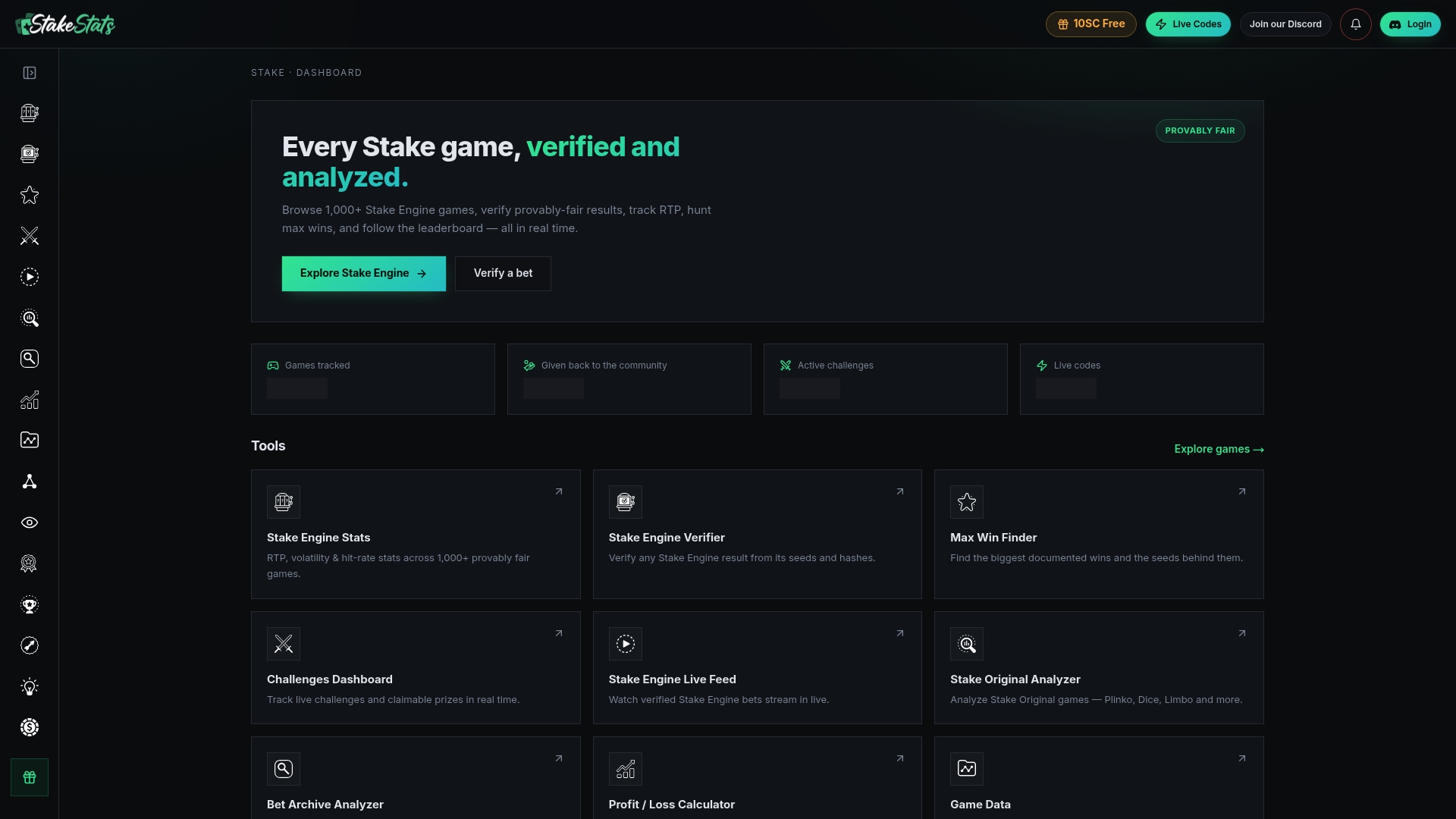
If you want the inputs for your next plan in one place, Stakestats gives you live RTP, volatility and hit rate stats for 2500+ Stake Engine games, seed and nonce bet verification, bankroll analyzers and guides written for crypto gamblers. Start at Stakestats and pick the game before you pick the target.
Then use the 5-step session plan to turn the stats into a loss limit, bet size, time cap and win target you can write down.
FAQ
What is a good win goal for a casino session?
There is no universal number, because it depends on your session roll, bet size and the game. A common structure is a win target of about half the session roll with a loss limit equal to the session roll, as in the $100 roll and +$50 target above. Whatever you choose, set it before you play and make sure you can reach it within your time cap at your bet size.
Should I stop playing when I reach my win goal?
Stopping is the simplest and most reliable choice. If you want to continue, move at least half the profit out of your session balance first and keep the original loss limit and time cap. Never raise the target repeatedly during a session, because that turns the goal into a moving line.
Can a win goal improve my odds?
No. Every bet has the same house edge whether you are ahead or behind, and provably fair verification confirms a result followed the game's math without promising a win. A win goal improves your decisions about when to leave and how much to risk, which is what you control.
How do I know if my goals are realistic?
Log each session with the plan and the outcome. After a couple of dozen sessions, check how often you reached the win target, the loss limit or the time cap. If the win target almost never triggers, lower it or increase your bet count; if the loss limit often triggers, shrink your session roll or bet size.
What if gambling stops feeling like a choice?
If you are chasing losses, hiding play or spending money you cannot afford to lose, contact the National Council on Problem Gambling for confidential help. Its responsible gambling guidance also advises betting only non-essential income and never gambling while impaired.
Sources
- Guidelines for a Healthy Relationship with Gambling, Oregon Council on Problem Gambling
- National Council on Problem Gambling responsible gambling guidance
- Setting limits and budgets, GameSense by AGLC
- Understand Bet Verification Results, ProvablyFair.org
- Safe Gambling Practices: A Checklist, rg.org
- Bankroll management for sports bettors